
Surviving the Freeze: Managing Tree Removal After an Ice Storm
Safe Storm Damaged Tree Removal Starts With Distance and Documentation
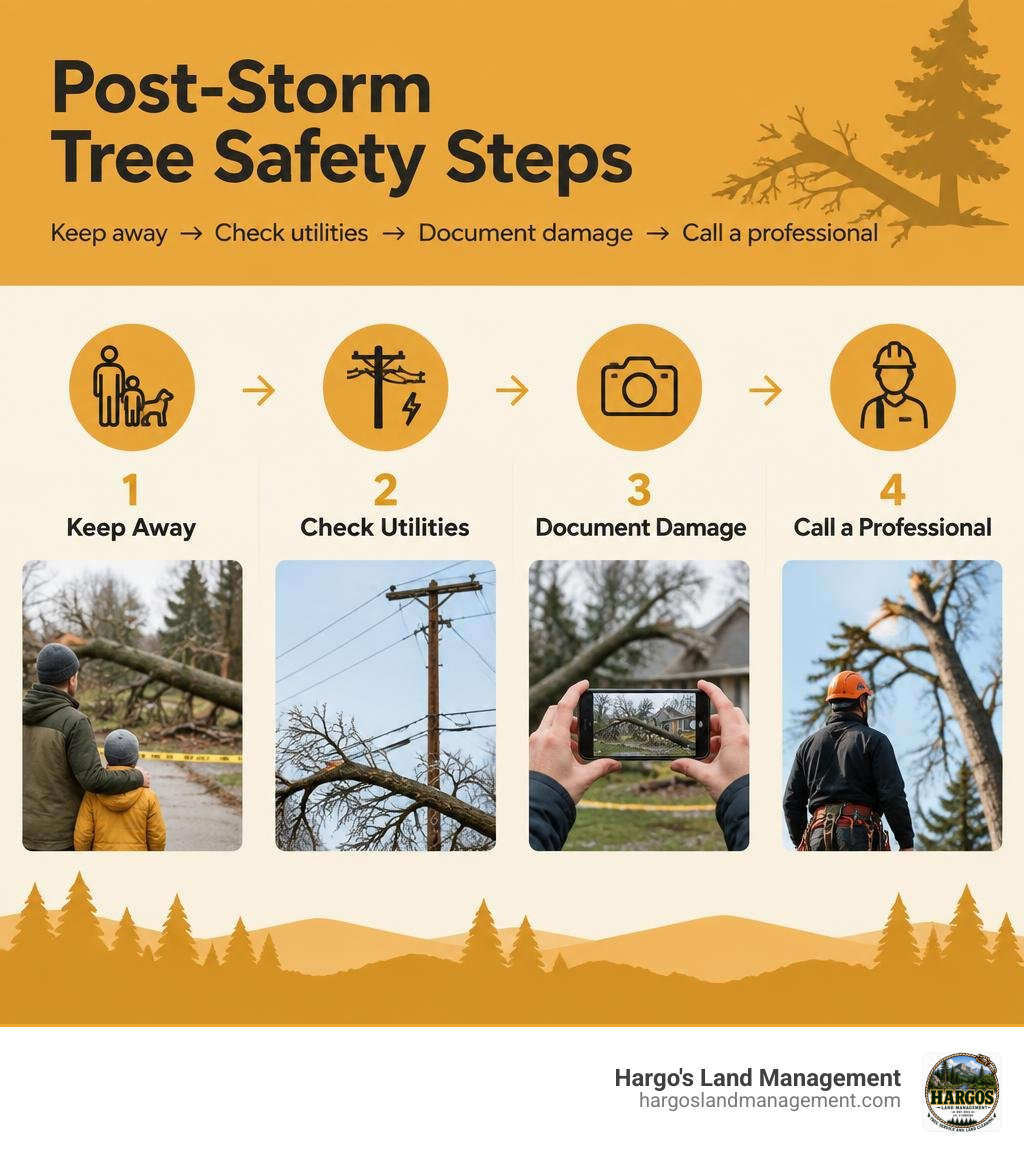
After an ice storm, keep people and pets away from damaged trees, assume nearby power lines are live, photograph the damage, and call a qualified tree professional before cutting anything. Do not use a ladder, pull on hanging limbs, or cut branches trapped under tension. Ice-loaded wood can snap or spring back without warning.
Treat the situation as an emergency when a tree or large limb is on a home, vehicle, or access route; a trunk is split; roots are lifting from the ground; or branches are touching utility lines. Stay at least 35 feet from a downed line or anything in contact with it, then contact the utility company or emergency services. The National Weather Service provides additional guidance on ice storm safety and recognizing hidden hazards after freezing precipitation.
For El Dorado County property owners, fast action also helps limit future hazards. A broken tree can leave hanging limbs, unstable trunks, and extra brush that may affect defensible space once conditions dry out. Storm damaged tree removal is not just cleanup – it is controlled hazard removal.
Essential storm damaged tree removal terms:
Immediate Post-Storm Safety Hazards and Triage
When a freeze hits the Sierra Nevada foothills, the weight of accumulated ice and snow can turn familiar backyard trees into ticking hazards. The quiet landscape after an ice storm often conceals high mechanical stress within standing canopies. Before stepping outside with a chainsaw or letting pets roam the yard, assessing immediate threats is essential.
Identifying Urgent Hazards: Widow Makers and Power Lines
The most urgent danger after any winter storm involves overhead utility infrastructure and overhead tree debris. Broken branches lodged precariously in the upper canopy—often referred to by arborists as “widow makers”—can dislodge hours or even days after the storm has passed. A slight breeze, warming temperatures, or the melting of ice can trigger a sudden fall.
Downed electrical wires represent an even greater hazard. A broken power line does not need to spark or hum to be deadly; it can energize the soil in a wide radius.
- Stay back at least 35 feet: A downed line can energize the surrounding ground for a radius of 35 feet or more. Keep family members and pets well beyond this distance.
- Avoid energized fences and metal gates: Chain-link fences, guardrails, and wet landscape structures can conduct deadly electrical currents hundreds of feet from the point of contact.
- Watch for spring poles: Bent branches caught beneath fallen logs or heavy snow pack store massive kinetic energy. Cutting into tension-loaded wood can cause the limb to snap open violently, resulting in severe blunt-force injuries.
For trees intertwined with wires or leaning against utility lines, always notify your utility provider first. Our team provides safe high risk tree removal solutions for hazardous trees near you once the electrical grid has been declared safe and deactivated by utility crews.
When to Request Emergency Storm Damaged Tree Removal
Not every broken branch requires an immediate middle-of-the-night dispatch, but true structural emergencies require rapid intervention. We triage post-storm calls based on property risk, structural compromise, and safety hazards.
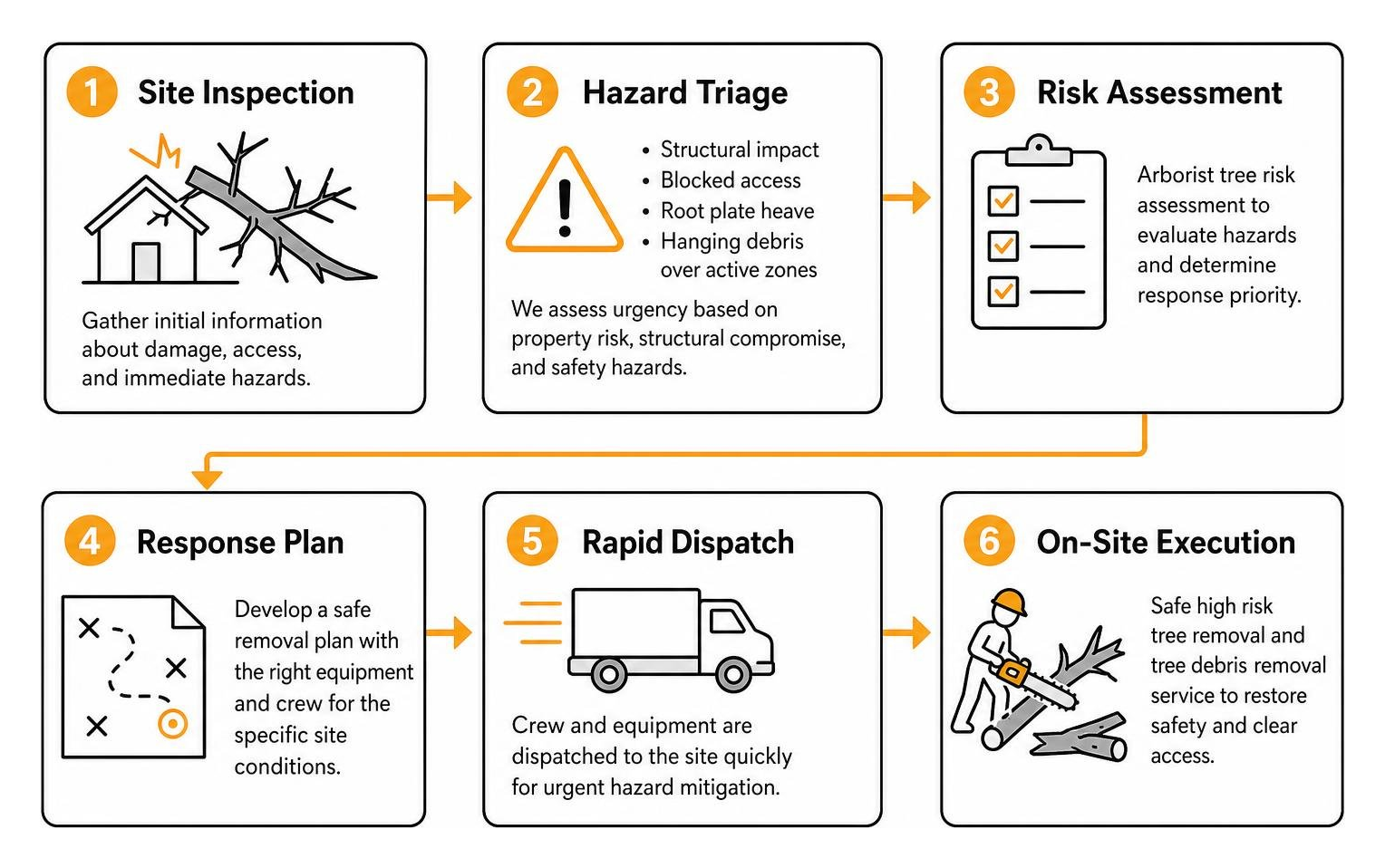
You should call for immediate emergency storm cleanup and extraction when you observe:
- Direct structural impact: A trunk or heavy limb has crashed through a roof, punctured an exterior wall, or compromised structural framing.
- Blocked access routes: Fallen timber is trapping vehicles, blocking driveways, or preventing emergency vehicles from accessing your mountain home.
- Severe root plate heave: The ground beneath the tree has lifted, exposing torn roots and leaving the trunk at a steep angle toward your home or garage.
- Hanging debris over active zones: Unstable limbs are suspended directly over entrances, walkways, or frequently occupied outdoor living areas.
Non-hazardous debris—such as small scattered branches on open turf or detached limbs resting safely on flat ground away from structures—can wait for scheduled daytime cleanup.
Assessing Ice Damage: Can the Tree Be Saved or Must It Be Removed?
Once emergency hazards are secured, property owners face a tough choice: can a damaged tree be restored, or does it pose too much risk to remain standing? Evaluating a tree’s structural integrity requires looking past surface-level foliage loss to examine the trunk, branching architecture, and root anchor system.
Evaluating Crown Loss, Stem Failure, and Trunk Cracks
The crown of a tree acts as its engine, converting sunlight into the carbohydrates needed for recovery, growth, and natural defense against pests. Severe ice accumulation frequently tears out major scaffold branches, leaving open wounds.
- The Crown Loss Threshold: As a general rule, healthy trees that lose less than roughly a third to half of their live crown can often be preserved through restorative structural pruning. However, trees that have lost more than 50% of their canopy generally struggle to produce enough energy to heal large tear wounds, making eventual decline and decay far more likely.
- Stem Failure (Broken Trunks): If the primary trunk snaps below the active crown, the tree cannot regain its natural, structurally sound form. Broken stems frequently reveal hollow pockets or internal decay that went unnoticed before the freeze. A broken main stem requires full extraction.
- Deep Trunk Splitting: Radial frost cracks or vertical splits along co-dominant stems (trunks that split into a “V” shape) severely compromise mechanical strength. Once the main structural column has split, the risk of total structural failure during the next windstorm rises significantly.
When dealing with massive specimens that have suffered structural failure, taking down a large tree in controlled sections prevents further damage to surrounding outbuildings and landscape features.
Leaning Trunks and Root Plate Failures
Ice storms in El Dorado County are often accompanied by heavy precipitation that saturates the soil. When freezing temperatures combine with soaked earth, root anchoring fails under the added weight of ice-laden branches.
A tree that leans noticeably after a storm has experienced root failure. Even if the trunk remains unbroken, the underground anchoring roots have torn and stretched. These trees rarely stabilize on their own; instead, compromised root systems can give way days or weeks later without warning.
| Damage Type | Visual Signs | Structural Risk Level | Recommended Action |
|---|---|---|---|
| Minor Branch Loss | Broken twigs, small branches under 2″ diameter | Low | Selective pruning and crown cleaning |
| Moderate Crown Loss | 20% to 40% canopy loss, intact primary trunk | Moderate | Crown restoration pruning by certified arborist |
| Major Crown Loss | >50% canopy stripped, torn branch collars | High | Comprehensive health evaluation; potential removal |
| Vertical Trunk Split | Deep fissure running down main stem or union | Extreme | Mandatory complete tree removal |
| Stem Failure (Snapped Trunk) | Main trunk broken off below live canopy | Extreme | Mandatory complete tree removal |
| Root Plate Lift | Soil mounding, exposed torn root ball, leaning trunk | Critical | Emergency removal; do not stand on the leaning side |
A formal evaluation by an arborist trained in Tree Risk Assessment Qualification (TRAQ) ensures that salvageable trees receive proper rehabilitation, while hazardous specimens are cleared before they collapse.
Navigating Homeowners Insurance and Permits for Storm Damaged Tree Removal
Managing property repairs after severe weather can feel overwhelming. Understanding how your insurance policy handles storm damage and what local documentation is required can prevent unexpected out-of-pocket costs and claim delays.
Step-by-Step Insurance Claim Process for Tree Damage
Homeowners insurance policies are designed to protect against unexpected, catastrophic losses caused by covered perils like wind, snow, and ice. However, coverage parameters depend heavily on where the tree lands and what it damages.
To give your claim the best chance of smooth processing, follow this step-by-step workflow:
- Document everything thoroughly before touching a branch: Take wide-angle photos showing the tree’s position relative to your home, outbuildings, fences, or vehicles. Take close-up shots of roof punctures, crushed gutters, broken structural beams, and the lifted root ball.
- Take video walkthroughs: Record a narrated video capturing the full scene, noting date and weather conditions.
- Prevent secondary damage: Insurance policies require property owners to take reasonable steps to prevent further losses. Tarping punctured roofs or boarding up broken windows is acceptable, but do not attempt dangerous heavy tree cutting yourself.
- Obtain detailed professional estimates: Reach out to a fully licensed tree contractor to secure a written estimate that itemizes the crane extraction, structural clearing, and debris disposal.
- Review coverage parameters: Homeowners insurance typically covers tree removal when a tree falls on a covered structure (such as a house, garage, shed, or fence). If a tree falls in the middle of a yard without hitting anything, insurance generally does not cover removal, though exceptions exist if the fallen trunk blocks an active driveway.
Our team routinely assists homeowners with storm damage tree removal insurance claims and safe cleanups, providing the exact photographic logs and itemized scopes of work adjusters require.
Local Tree Removal Permits and Avoiding Storm Chaser Scams
Following major weather events, predatory out-of-town operators—often called “storm chasers”—frequently knock on doors offering cheap, cash-only tree removal. These crews often lack proper licensing, worker’s compensation, or commercial liability insurance. If an uninsured worker is injured on your property or drops a limb through your roof, you could be held financially and legally liable.
Always check a company’s credentials before allowing equipment onto your land:
- Verify active licensing and bonding: Work only with licensed, bonded contractors who specialize in high-risk arboricultural work.
- Demand direct proof of insurance: Request a Certificate of Insurance issued directly from the insurer showing general liability and full worker’s compensation coverage. Reviewing why proof of tree removal insurance matters so much can save you from catastrophic liability.
- Understand permit requirements: In many residential jurisdictions, removing protected or landmark tree species requires a municipal permit. However, emergency situations involving imminent hazards or severe storm damage often allow for immediate removal under emergency permit waivers, provided the danger is documented by a certified tree professional prior to felling.
The Professional Storm Damage Tree Removal Process
Removing a storm-damaged tree is far more complex than standard felling. Storm-damaged trees are under severe mechanical tension, with structural support shifted onto broken branches or resting directly on roofs and power infrastructure.
Safe Rigging, Crane Extraction, and Sectional Dismantling
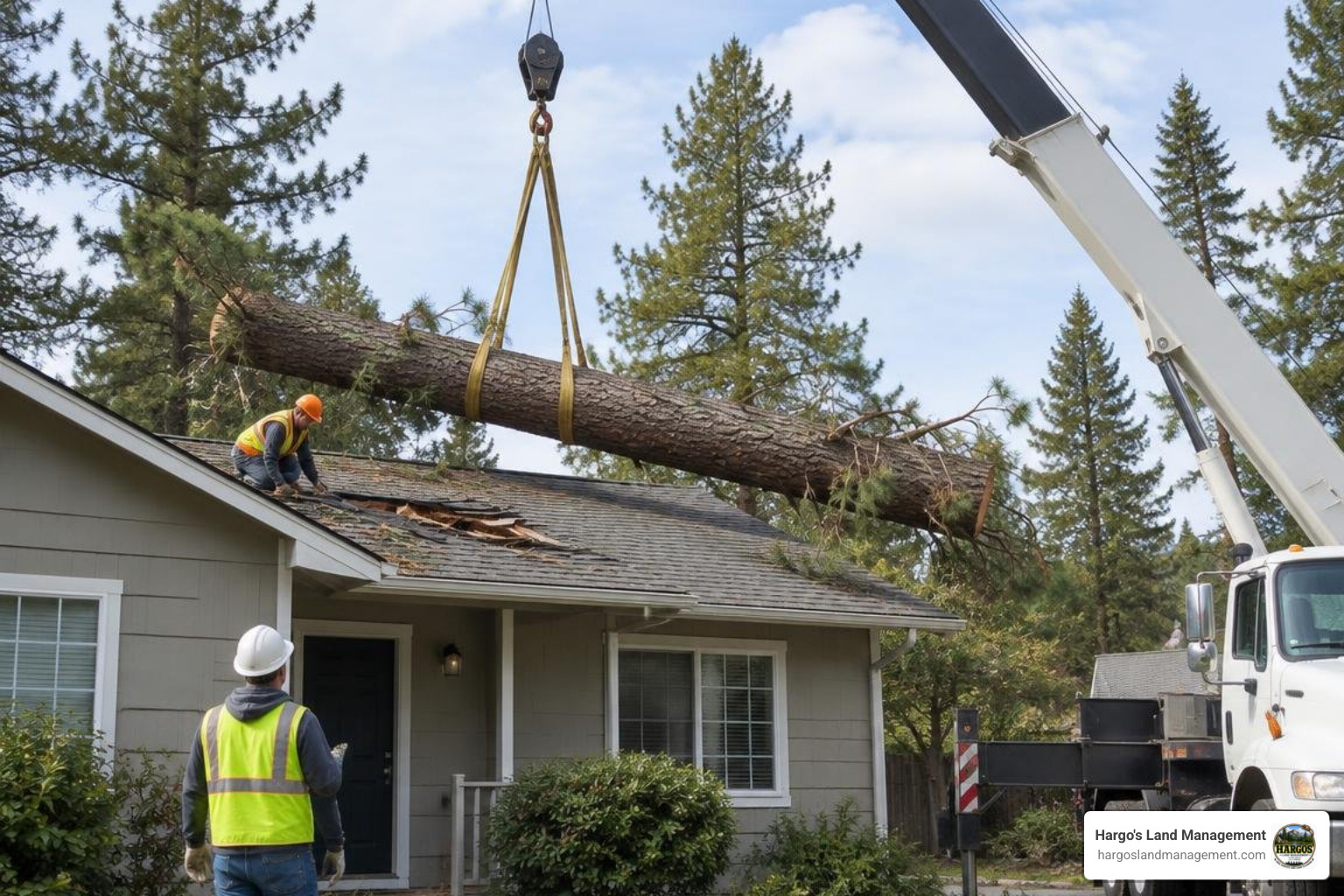
When a heavy pine, oak, or cedar is resting on a home, cutting it in place without proper support can cause the trunk to shift, punching new holes through the roof decking. Professional crews rely on specialized rigging and heavy machinery to stabilize the load before making a single cut.
- Crane-Assisted Removals: For trees leaning over houses or resting on structures, mobile cranes lift entire sections vertically off the building. This eliminates lateral pressure, preventing secondary roof damage.
- Tension and Compression Management: Professional arborists analyze internal wood forces. When a trunk is bent under ice load, one side is compressed while the other is under immense tension. Cutting the wrong side first causes the wood to barber-chair or snap outward violently. Controlled relief cuts allow tension to dissipate safely.
- Aerial Lifts and Rigging Blocks: Where crane access is limited, climbers and lift operators use high-capacity friction brakes and rigging blocks to lower heavy branch sections to the ground one piece at a time.
Complete Site Cleanup and Stump Grinding
Emergency extraction is only half the battle. Once the structural hazard is dismantled, properties are often left covered in shattered limbs, broken branch wood, and massive trunk rounds.
A comprehensive cleanup involves chipping brush on-site, hauling away unmanageable timber, and restoring clear access to pathways and yards. To understand the complete scope of post-hazard cleanup, review what to expect from a tree debris removal service.
Once the tree is safely on the ground, leaving a broken, jagged stump can attract pests such as bark beetles and wood-boring ants. In addition, exposed stumps can create tripping hazards and complicate future landscape improvements. Investing in mechanical stump grinding eliminates the root collar well below ground grade, allowing the area to be replanted or re-graded. When planning post-storm cleanup costs, budgeting for tree removal and stump grinding services helps you manage the entire property restoration efficiently.
Proactive Maintenance: Preparing Trees Before Winter Storms
The best time to manage storm damage is before the freezing rain and heavy snowfall arrive. Proactive arboricultural maintenance dramatically reduces the likelihood of tree failure during extreme winter weather.
Preventive Pruning and Structural Thinning for Winter Prep
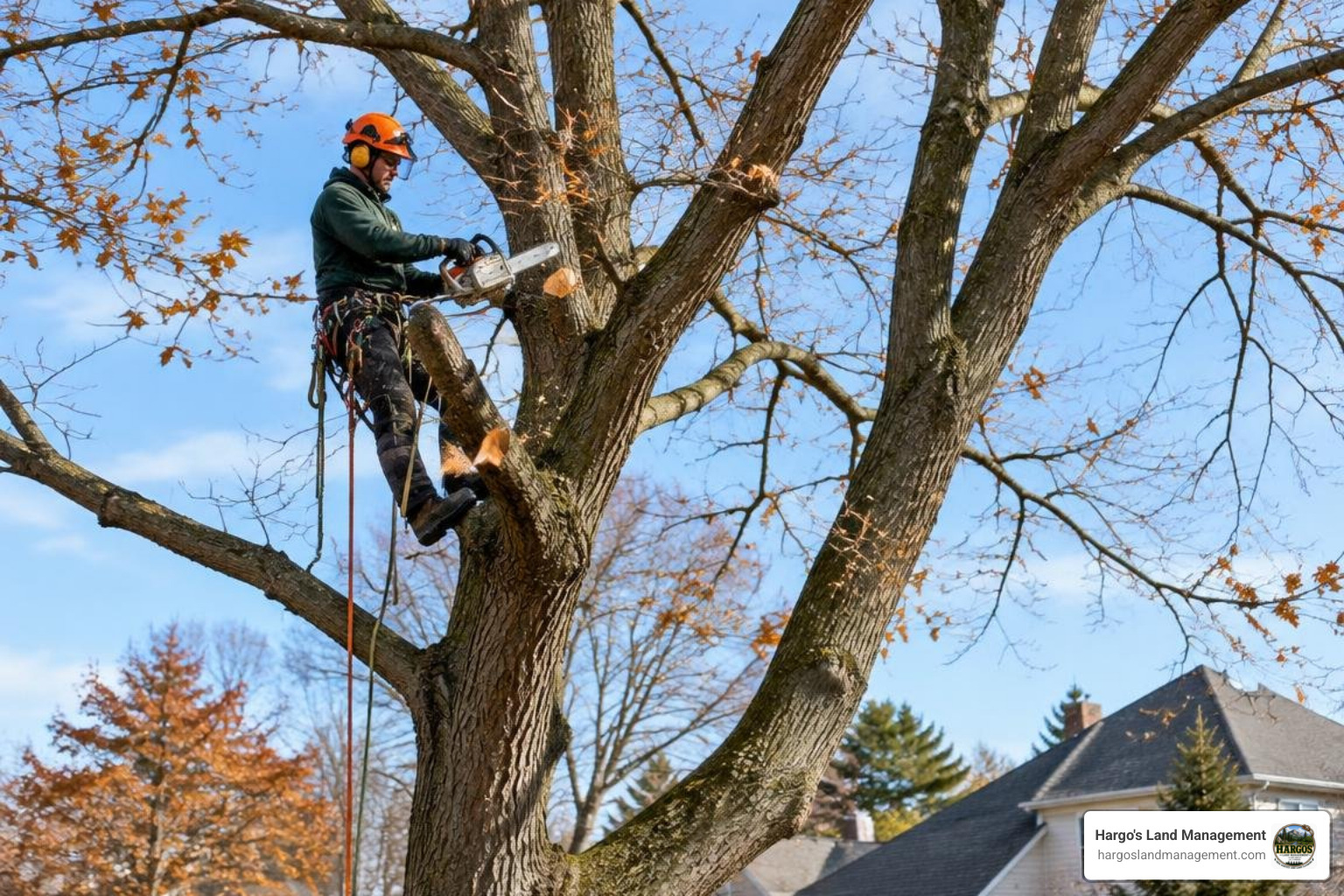
Trees that receive regular structural care withstand severe weather far better than unmaintained specimens. Experience from major weather events shows that property owners who follow routine pruning recommendations rarely experience catastrophic failures during winter storms.
Essential proactive measures include:
- Structural Pruning and Crown Thinning: Selectively thinning the outer canopy reduces the total surface area available for heavy ice and wet snow to accumulate, allowing winter winds to pass through the canopy with less drag.
- Removing Dead, Diseased, and Dying Wood: Dead branches lack the elasticity of living wood and are the first to snap when loaded with ice. Removing deadwood eliminates easy break points before winter sets in.
- Mitigating Co-Dominant Stems: Trees with dual trunks of equal size joined at a tight “V” angle have weak branch unions prone to splitting under heavy ice loads. Crown weight reduction or professional structural support systems (such as non-invasive dynamic cabling) help protect these vulnerable unions.
- Maintaining Fire-Season Defensible Space: In regions like El Dorado County, winter tree maintenance serves a dual purpose. Clearing out dead lower limbs, thinning crowded ladder fuels, and maintaining proper canopy spacing protects your home from winter storm failures while keeping your property compliant with wildfire defensible space requirements.
Scheduling a seasonal inspection through our comprehensive tree service ensures your property’s canopy remains resilient year-round.
Frequently Asked Questions About Storm Damaged Tree Removal
Does homeowners insurance pay for storm damaged tree removal if no structure is hit?
In most cases, standard homeowners insurance policies do not cover the cost of removing a tree that falls harmlessly on open ground without damaging a covered structure (such as your home, detached garage, fence, or outbuilding).
However, many policies include limited coverage if the fallen tree blocks a primary driveway or a wheelchair-accessible ramp, preventing you from safely driving onto your property. If the tree fell on a boundary fence or outbuilding, coverage generally applies up to your policy’s structural limit, minus your deductible. Reviewing your policy’s parameters for insurance clearing before a storm occurs helps clarify what out-of-pocket costs to expect.
Can a leaning tree recover after a heavy freeze or ice storm?
A tree that leans significantly after an ice storm has sustained severe structural damage to its underground root anchor system. Saturated soils and the heavy weight of ice tear fine feeder roots and major structural taproots.
While young, flexible saplings can occasionally be restaked and saved, mature trees with lifted root plates cannot securely anchor themselves back into the ground. These trees present a major hazard and often collapse unexpectedly days or weeks later during moderate winds. A leaning mature tree should always be evaluated by a certified tree professional and typically requires removal.
Why is storm damaged tree removal more expensive than standard removal?
After severe storms, emergency tree extraction typically costs 1.5x to 2x standard felling rates. This pricing reflects several critical factors:
- Immediate Mobilization: Crews and heavy equipment operate around the clock, often in hazardous winter conditions with freezing rain, ice, or sub-zero temperatures.
- Extreme Mechanical Hazards: Storm-damaged wood is under unpredictable tension and compression, requiring complex rigging, aerial lifts, and crane support to prevent secondary structural impacts.
- Complex Rigging Demands: Extracting trees that have punctured roofs or are pinned against structures requires extra precision and time compared to routine dismantling in an open yard.
Conclusion
A severe ice storm can reshape your landscape in a matter of hours, turning valuable shade trees into major safety risks. Surviving the freeze requires patience, distance, and safety-focused action: stay well clear of downed power lines, never step beneath suspended limbs, document structural impacts thoroughly for insurance claims, and avoid taking unnecessary risks with tension-loaded wood.
Whether you need immediate crane-assisted extraction from a compromised roof or post-storm hazard assessments across your property, partnering with experienced, licensed, and bonded professionals protects your family, home, and land.
If you are dealing with broken, split, or hazardous trees in El Dorado County, South Lake Tahoe, or Placerville, reach out to Hargo’s Land Management to schedule your on-site assessment for professional hazardous tree removal. Our dedicated, fully insured team is here to restore safety, order, and defensible space to your mountain property.
CUSTOMER REVIEWS & TESTIMONIALS
We strive to exceed your expectations. See what our customers have to say.



















CONTACT US TODAY
Serving El Dorado and Surrounding Counties
Locally owned and operated since 2013. Use our live chat support to get in touch about your land management needs today.
Request a free evaluation and estimate by completing our online form or book an on-site appointment.
El Dorado County: El Dorado Hills, Cameron Park, Shingle Springs, Coloma, Placerville, Camino, Pollock Pines, South Lake Tahoe and more...
Amador County: Jackson, Ione, and Surrounding Towns
Sacramento County: Sacramento and Surrounding Cities
Placer County: Roseville, Rocklin, Auburn, and Everything In Between
Nevada County: Penn Valley, Nevada City, Grass Valley