Navigating El Dorado County Tree Removal Regulations and Permits
Know When an El Dorado County Tree Removal Permit Is Required
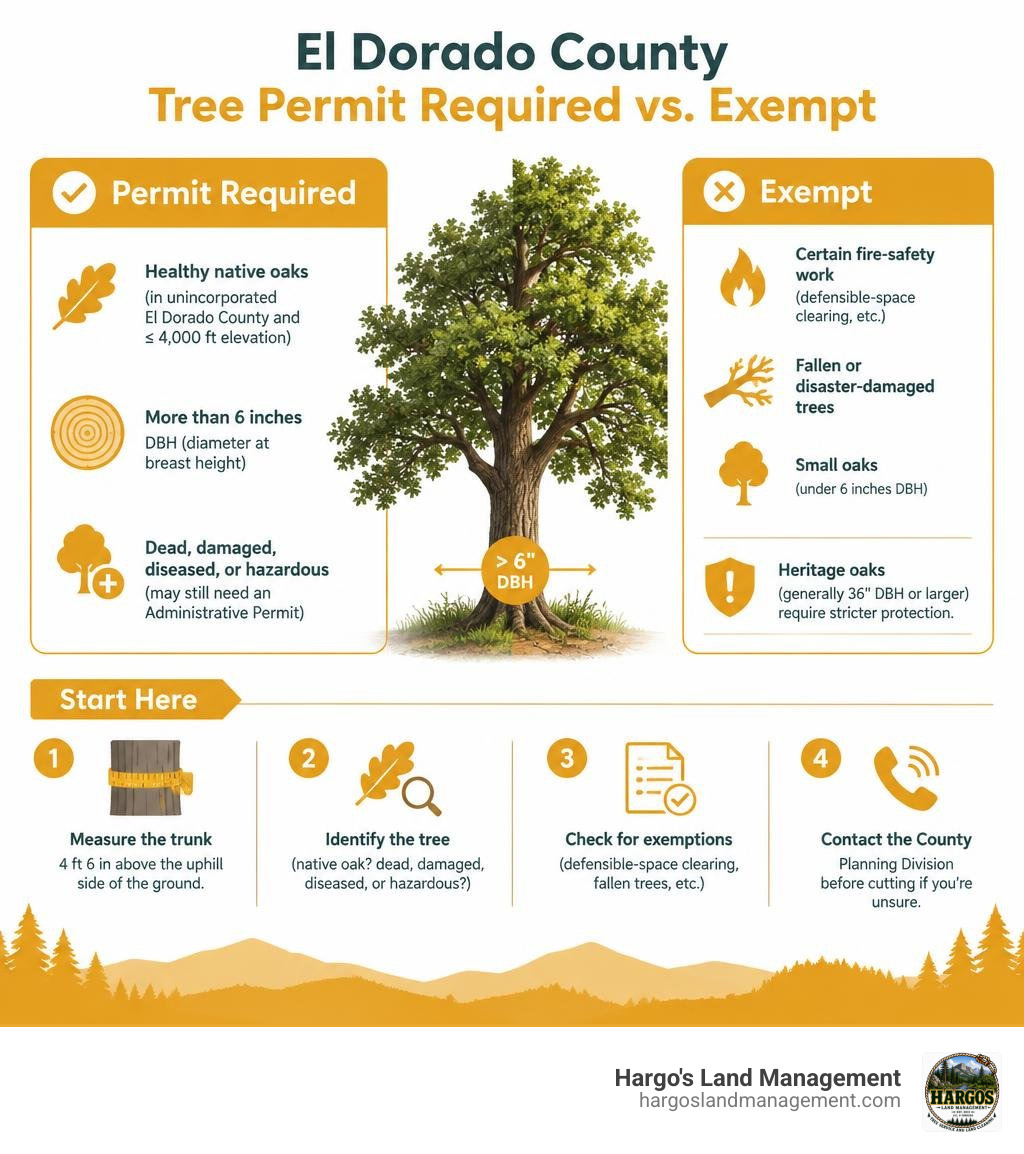
Before removing a tree, first confirm whether your property is in unincorporated El Dorado County and at or below 4,000 feet elevation. Healthy native oaks in this area often require an El Dorado County tree removal permit, especially if they measure more than 6 inches in diameter at breast height (DBH).
Start with these steps:
- Measure the trunk 4 feet 6 inches above the uphill side of the ground.
- Identify whether it is a native oak and whether it is dead, damaged, diseased, or hazardous.
- Check whether the work qualifies as defensible-space clearing or another exemption.
- Contact the County Planning Division before cutting if you are unsure.
Some removals are exempt, including certain fire-safety work, fallen or disaster-damaged trees, and small oaks. But dead or diseased oak removals can still require an Administrative Permit and written documentation from a qualified professional. A heritage oak, generally 36 inches DBH or larger, has stricter protection and much higher risk if removed without approval.
Wildfire safety matters, but it does not mean every tree can be removed without checking the rules. Clear documentation and early permit review can protect your home, budget, and project schedule.
El dorado county tree removal permit terms to learn:
When Do You Need an El Dorado County Tree Removal Permit?

Navigating tree preservation rules in our Sierra Nevada foothills can feel tricky, especially when balancing natural resource conservation against wildfire preparedness. In unincorporated El Dorado County, tree protection standards are codified under County Code Chapter 130.39 (Ordinance 5061), officially recognized as the Oak Resources Conservation Ordinance – El Dorado County.
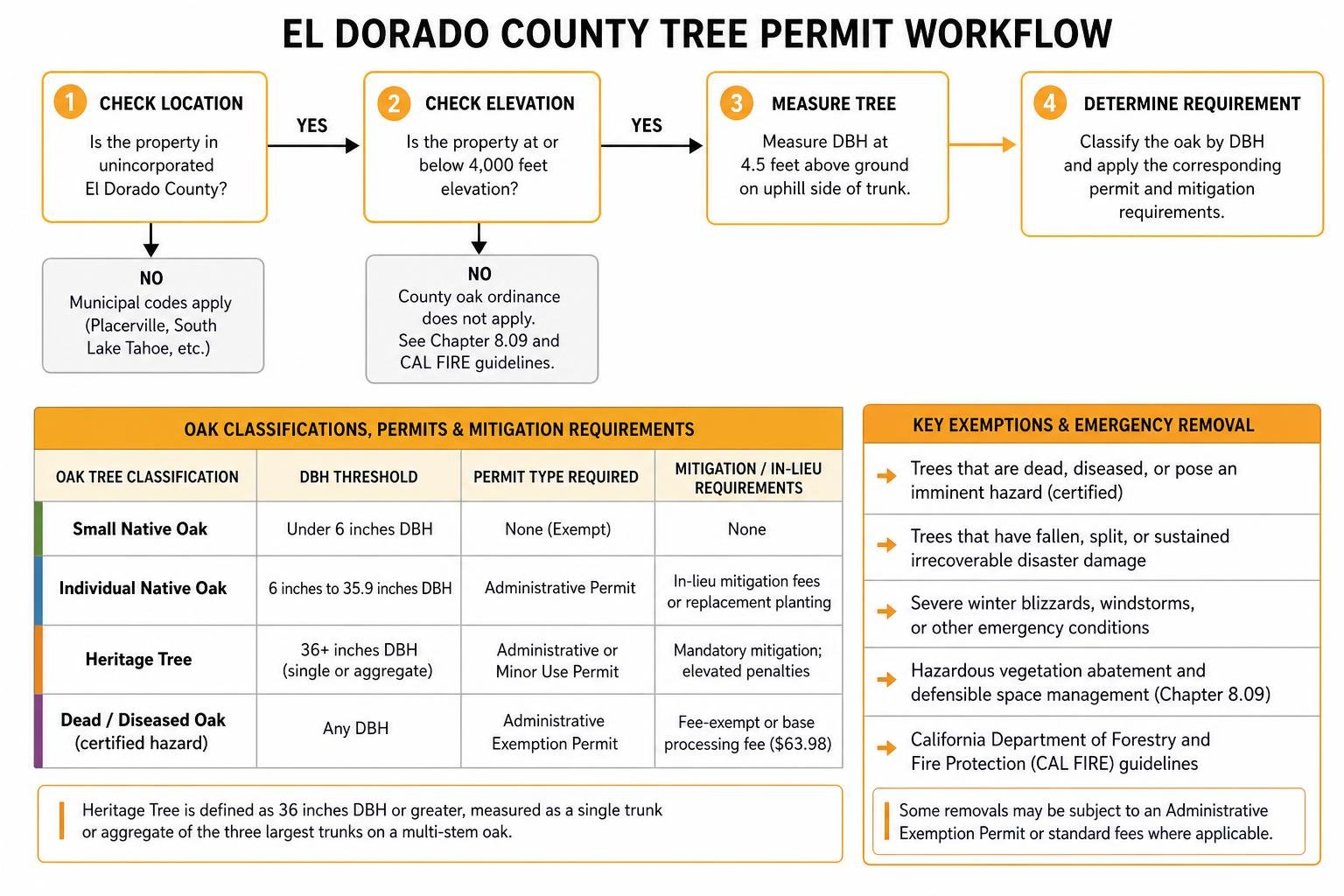
The county framework dictates that any discretionary development, grading, or intentional removal impacting native oak resources below the 4,000-foot elevation threshold must obtain regulatory clearance. The foundational baseline for evaluating whether a permit is necessary involves checking the diameter at breast height (DBH), measured at exactly 4.5 feet above the ground on the uphill slope of the trunk.
For properties located within municipal boundaries such as Placerville or South Lake Tahoe, local municipal codes govern landscaping alongside standard Tree Removal, El Dorado County, CA | CityRuleLookup criteria. Throughout the unincorporated foothill communities, the county’s Oak Resources Management Plan sets precise thresholds for single-trunk and multi-trunk oaks.
| Oak Tree Classification | DBH Threshold | Permit Type Required | Mitigation / In-Lieu Requirements |
|---|---|---|---|
| Small Native Oak | Under 6 inches DBH | None (Exempt) | None |
| Individual Native Oak | 6 inches to 35.9 inches DBH | Administrative Permit | In-lieu mitigation fees or replacement planting |
| Heritage Tree | 36+ inches DBH (single or aggregate) | Administrative or Minor Use Permit | Mandatory mitigation; elevated penalties |
| Dead / Diseased Oak | Any DBH (certified hazard) | Administrative Exemption Permit | Fee-exempt or base processing fee ($63.98) |
Classifications of Protected Oaks and Heritage Trees
The county defines specific native oak species that fall under strict canopy and stem protection rules:
- Valley Oak (Quercus lobata): Considered a sensitive foothill habitat, receiving strict preservation oversight.
- Blue Oak (Quercus douglasii): Common across our drier foothill slopes, forming over 26% of local oak woodland acreage.
- Interior Live Oak (Quercus wislizeni) and California Black Oak (Quercus kelloggii): Heavily integrated into residential parcel canopies.
An Individual Native Oak is defined as any healthy native oak measuring between 6 and 35.9 inches DBH. When an oak reaches 36 inches DBH—either as a single stem or as a cumulative aggregate measurement of the three largest trunks on a multi-stem tree—it is legally classified as a Heritage Tree. Heritage trees are granted premium status, meaning any unpermitted disturbance triggers extensive Oak Resources Technical Reports, public planning reviews, and steep replacement ratios.
How Elevation Affects Your Permit Requirements
Elevation plays a direct role in determining local regulatory jurisdiction. The Oak Resources Conservation Ordinance explicitly applies to private parcels situated at or below 4,000 feet elevation.
If your parcel is situated above 4,000 feet in the higher Sierra elevations or within the Lake Tahoe Basin, Chapter 130.39 oak conservation rules yield to regional timber and vegetation frameworks. However, parcels above 4,000 feet remain strictly governed by El Dorado County Code Chapter 8.09 for hazardous vegetation abatement and defensible space management, alongside California Department of Forestry and Fire Protection (CAL FIRE) guidelines.
Key Exemptions and Emergency Tree Removal Rules
While the county maintains rigid conservation policies for healthy native woodlands, property owners are not left helpless when dealing with structural hazards, beetle infestations, or urgent fire threats. As highlighted when Oak ordinance revisions take root | News | mtdemocrat.com, revisions and Urgency Ordinance measures have established clear exemptions for property owners facing genuine risks.
When severe winter blizzards or foothill windstorms strike, navigating storm damage tree removal quickly becomes an emergency priority. Trees that have fully fallen, split structurally, or sustained unrecoverable disaster damage can be cleared immediately without standard advance mitigation permits.
Other standard exemptions include:
- Personal-Use Firewood: Property owners may remove up to 8 native oaks or a cumulative total of 140 inches DBH per parcel per calendar year for personal firewood or property maintenance without mitigation fees (provided they are not Heritage Trees).
- Agricultural Activities: Land clearing actively supporting ongoing agricultural operations, ranching, or grazing on verified agricultural parcels.
- Public Utility and Road Clearance: Routine utility corridor clearance, line protection, and county road right-of-way safety maintenance.
- Dead, Dying, and Diseased Stems: Removing dead oaks or stems decimated by bark beetles, provided an arborist certifies the condition. For severe structural risks, choosing safe high-risk tree removal solutions for hazardous trees ensures safety while keeping your documentation airtight.
Wildfire Defensible Space and CAL FIRE PRC 4291 Clearance
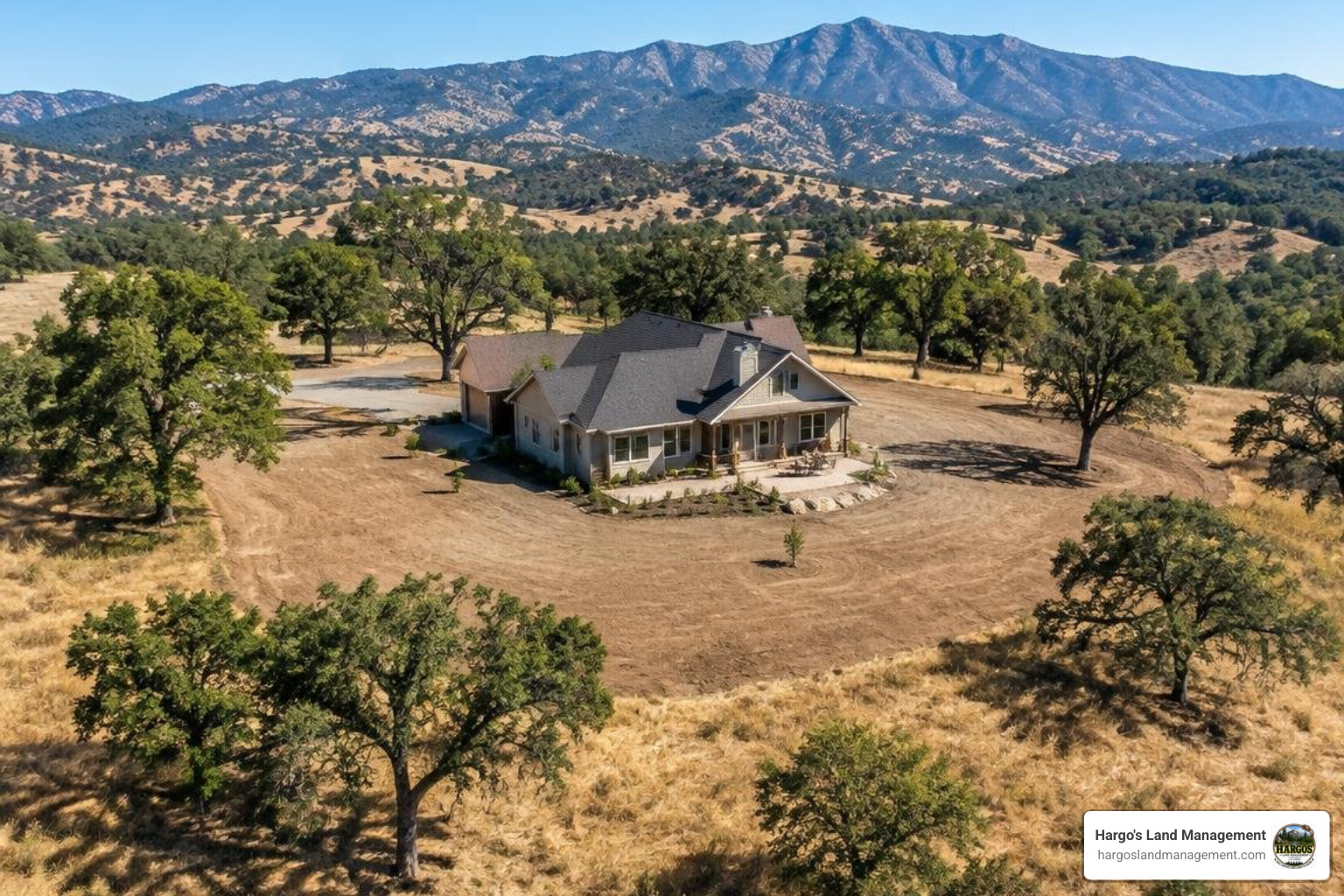
Under California Public Resources Code (PRC) § 4291 and County Code Chapter 8.09, establishing and maintaining a 100-foot defensible space perimeter around occupied homes and outbuildings is a legal requirement. Approved defensible-space activities are exempt from oak mitigation fees.
Local fire protection districts and CAL FIRE enforce the following critical clearance standards:
- Zone 0 (0–5 feet): Non-combustible ember-resistant zone directly against home siding and decks.
- Zone 1 (5–30 feet): Clean, lean, and green zone where tree crowns must maintain 10 to 18 feet of separation.
- Zone 2 (30–100 feet): Fuel reduction zone where low vegetative fuel ladders are eliminated.
- Vertical Infrastructure Clearance: All tree branches must be pruned back at least 10 feet from chimney outlets and stovepipes.
- Emergency Road Clearance: Maintaining at least 15 feet of continuous vertical clearance over driveways and roadways to allow unimpeded access for fire engines, matching standards detailed in Tree Trimming in El Dorado County, CA (2026) | CityRuleLookup.
Routine limbing and canopy thinning do not require permits as long as pruning does not destabilize or destroy protected individual native oaks.
Documenting and Permitting Hazard Trees for Insurance
Foothill homeowners frequently face insurance policy non-renewals or hazard abatement notices demanding the prompt removal of large trees hanging over roofs.
When an insurer requires removal, scheduling a certified arborist tree risk assessment is the critical first move. A written hazard certification prepared by a qualified professional (such as an ISA Certified Arborist or Registered Professional Forester) verifies that the tree poses an active threat to life or property. Under county urgency guidelines, insurance-mandated and hazardous tree permit requests are expedited, frequently receiving administrative clearance within 7 business days.
How to Apply for an El Dorado County Tree Removal Permit Step-by-Step
When an oak removal does not meet standard personal-use or emergency exemptions, you must submit a formal application to the El Dorado County Planning and Building Department.
- Conduct a Preliminary Site Survey: Determine total parcel acreage, elevation, species type, and DBH measurements.
- Draft a Comprehensive Site Plan: Map property boundaries, existing driveways, structures, utility easements, and the exact locations of trees scheduled for removal versus those marked for preservation.
- Obtain Technical Arborist Documentation: For larger discretionary projects, retain a certified professional to complete an Oak Resources Technical Report matching the standards in the Oak Resources Management Plan.
- Submit Application Forms: File an Administrative Permit application (or Minor Use Permit for major commercial and woodland clearing) with county planning staff.
- Remit Application Fees: Pay the appropriate administrative filing fee. An exemption application requires a nominal fee of $63.98, while standard discretionary permit processing starts at $445.82.
- County Review and Site Inspection: County staff verify site measurements, review mitigation proposals, and issue your formal Oak Resources Code Compliance Certificate.
Working with an ISA Certified Arborist on Technical Reports
Navigating county planning reviews requires professional documentation. Partnering directly with an ISA certified arborist ensures your technical reports satisfy all Chapter 130.39 benchmarks on the first submittal.
A full Oak Resources Technical Report provides:
- Comprehensive tree inventory recording species, DBH, canopy spread, and baseline physiological vigor.
- Quantified structural risk evaluations identifying internal rot, root rot, or severe lean.
- Exact calculation of oak canopy impacts across development envelopes.
- Recommended on-site tree protection fencing protocols during heavy equipment operations.
Calculating In-Lieu Mitigation Fees and Replacement Planting
When development requires removing healthy protected oaks, the county mandates formal environmental mitigation through one of two pathways:
- On-Site Replacement Planting: Planting container-grown native saplings on your property, paired with an enforceable 7-year monitoring and maintenance agreement to guarantee root establishment and survival.
- In-Lieu Mitigation Fees: Paying a calculated fee per inch of trunk DBH removed (or per acre of oak woodland canopy displaced). These collected fees feed directly into county conservation funds dedicated to purchasing regional conservation easements.
Qualifying residential developments incorporating at least 10% deed-restricted affordable housing units can receive specific reductions in oak woodland mitigation ratios, streamlining local community housing needs.
Impacts of Site Clearing, Parking, and Development Rules
Tree removal permits regularly intersect with broader site preparation, grading, and civil infrastructure rules. If you are preparing raw land for residential construction, understanding the steps for land clearing for construction will help keep your site prep aligned with local environmental rules.
Before scheduling heavy excavators, evaluating what land clearing for development actually costs ensures your budget accounts for grading permits, CEQA compliance checks, and oak mitigation costs.
Furthermore, removing mature canopy trees across commercial or multi-family properties directly affects parking regulations. County Code Table 17.70-5 mandates specific on-site vehicle parking ratios (often 1 space per 250 sq. ft. of gross floor area) and tree canopy shading to combat urban heat islands and reduce stormwater runoff. If canopy removal alters parking configurations by more than 35%, commercial property owners must submit revised landscaping and parking plans before receiving a final Certificate of Occupancy.
Avoiding Penalties and Unpermitted Removal Fines
Cutting down protected native oaks without required county permits carries severe consequences:
- Immediate Stop-Work Orders: County code enforcement officers will immediately freeze all on-site construction, grading, and building inspections.
- Triple-Damage Fines: Standard unpermitted oak removals trigger punitive fines calculated at up to 3 times the standard replacement and mitigation fee.
- Heritage Oak Penalties: Removing an unpermitted Heritage Tree (36+ inches DBH) exposes the property owner to fines of up to 9 times the tree’s assessed market value.
- Title Liens and Permitting Holds: Unpaid penalties result in direct property tax liens and multi-year holds on future building permits.
To protect your investments, ensure any contractor working on your property carries comprehensive liability and workers’ compensation coverage; learning why proof of tree removal insurance matters so much can save you from catastrophic third-party liabilities during hazardous tree felling.
Frequently Asked Questions About El Dorado County Tree Removal Permits
Do I need an El Dorado County tree removal permit to cut down a pine tree?
Generally, no permit is required under Chapter 130.39 to remove non-oak conifer species—such as Ponderosa pine, gray pine, or Douglas-fir—on private residential parcels in unincorporated foothill areas. However, if your property is within an incorporated city, inside the Lake Tahoe Basin, or subject to commercial timber harvesting rules under a CAL FIRE Timber Harvest Plan, specific harvesting and clearing permits apply.
Can I remove an oak tree for defensible space without paying mitigation fees?
Yes. Approved defensible space operations designed to meet CAL FIRE PRC 4291 and local fire district standards (clearing within 100 feet of a permitted structure) are fully exempt from mitigation fees under the county’s official FREQUENTLY ASKED QUESTIONS guidance. We always recommend photographing the tree’s position relative to your home before beginning work to maintain a clear compliance record.
What qualifications must a professional have to document tree hazards in the county?
Under County Code Chapter 130.39, documentation for dead, dying, or structurally hazardous oaks must be signed by a designated Qualified Professional. This includes an ISA Certified Arborist with tree risk assessment credentials, a California Registered Professional Forester (RPF), or a qualified consulting wildlife biologist.
Conclusion
Protecting your foothill property from wildfire while maintaining full compliance with El Dorado County oak preservation ordinances does not have to be stressful. By understanding DBH thresholds, taking advantage of fire safety exemptions, and securing proper documentation before cutting, you protect both your property value and our region’s natural beauty.
At Hargo’s Land Management, our experienced team provides comprehensive residential and commercial tree service, specialized fire-season fuel reduction, and professional site clearing. Serving communities throughout our broad service areas across El Dorado County—including Placerville, Cameron Park, El Dorado Hills, and South Lake Tahoe—we are locally owned, licensed, bonded, and fully insured.
Contact us today to schedule your free on-site assessment and get dedicated, professional support for your hazardous tree removal and local permit needs.
CUSTOMER REVIEWS & TESTIMONIALS
We strive to exceed your expectations. See what our customers have to say.



















CONTACT US TODAY
Serving El Dorado and Surrounding Counties
Locally owned and operated since 2013. Use our live chat support to get in touch about your land management needs today.
Request a free evaluation and estimate by completing our online form or book an on-site appointment.
El Dorado County: El Dorado Hills, Cameron Park, Shingle Springs, Coloma, Placerville, Camino, Pollock Pines, South Lake Tahoe and more...
Amador County: Jackson, Ione, and Surrounding Towns
Sacramento County: Sacramento and Surrounding Cities
Placer County: Roseville, Rocklin, Auburn, and Everything In Between
Nevada County: Penn Valley, Nevada City, Grass Valley