Clear the Danger Zone with Local Fire-Safe Landscaping Services
Find Defensible Space Clearing Near You Before Fire Season
For defensible space clearing near me in El Dorado County, choose a local, licensed, insured contractor who can inspect your property, identify fire fuels, and complete the right mix of brush clearing, tree pruning or removal, weed abatement, and mastication. Ask for an on-site assessment, a written scope of work, and clear guidance on maintaining each cleared area.
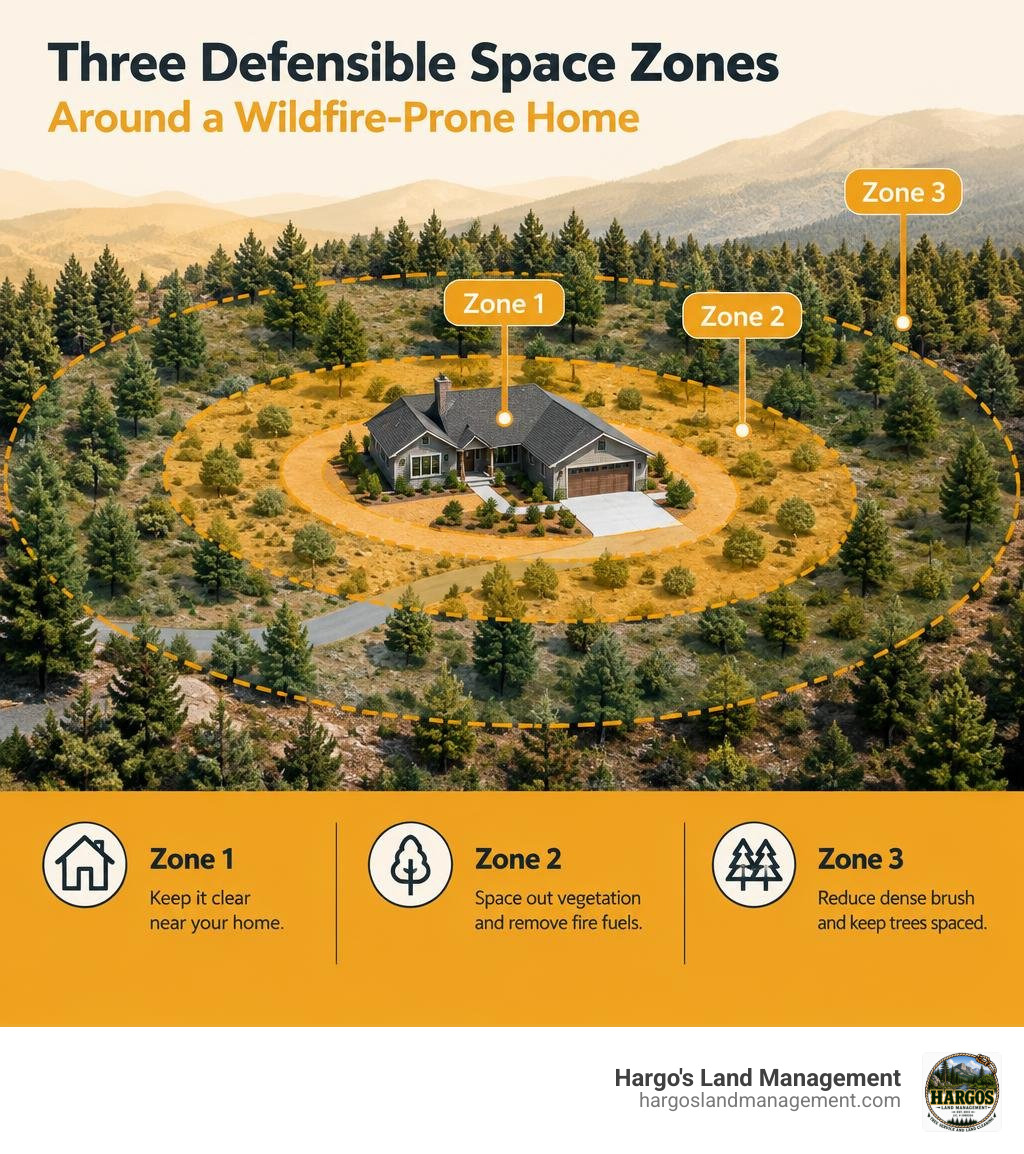
Defensible space is the managed area around a home or other structure where flammable vegetation is reduced and spaced apart. It slows fire near the building, limits ember-ready fuels, and gives firefighters safer access if a wildfire approaches.
For large or wooded properties, this work is not simply about making land look neat. It means addressing dense brush, low tree limbs, dead material, overgrown grasses, and hazardous trees while preserving healthy vegetation where practical.
Hargo’s Land Management has provided defensible space clearing, assessment, and evaluation throughout El Dorado and nearby counties since 2013. A local walkthrough can help you prioritize the highest-risk areas, prepare for fire inspections, and document mitigation work that may support insurance discussions.
Defensible space clearing near me terms to remember:
Why Wildfire Fuel Reduction and Defensible Space Matter
Living in the Sierra Nevada foothills and surrounding valleys offers incredible scenic beauty, but it also places our homes squarely in the wildland-urban interface. In regions like Northern California, wildfire is an ongoing reality rather than a rare event. When a blaze sweeps through dry brush and overgrown timber, radiant heat and flying embers become the primary threats to any structure in their path.
The primary goal of fuel reduction is to change fire behavior. Without proactive intervention, thick underbrush acts as a continuous fuel ladder, carrying ground fires directly up into the forest canopy and driving flames toward roofs, decks, and exterior walls.
The real-world data behind these efforts is staggering: fire professionals have reported that up to 75% of homes that survived in burn areas completed some form of defensible space mitigation. When you systematically clear dead vegetation, thin overcrowded tree stands, and eliminate combustible ladder fuels, you dramatically increase structural survivability.
Creating a buffer zone gives emergency crews a safe staging area to defend your residence. By actively working to reduce wildfire dangers before peak fire season arrives, you transform your land from an easy ignition source into a resilient barrier that protects your family, neighbors, and first responders.
Protecting Property Values and Improving Home Insurance Approvals
Beyond basic life safety, fire fuel management has become a financial necessity for homeowners. Over recent years, major insurance carriers across California and other fire-prone states have tightened underwriting requirements. Many property owners face non-renewal notices, skyrocketing premiums, or outright denials simply due to heavy brush encroaching on their structures.
Insurance underwriters look for measurable risk reduction. When you adhere to established guidelines by understanding defensible space zones and tree spacing rules, you create documented proof of property maintenance. Professional clearing contractors provide detailed invoices and mitigation reports that you can submit directly to your insurance agent.
Meeting these standards satisfies mandatory policy conditions and frequently unlocks valuable premium discounts, helping protect your property value and secure continuous coverage.
Core Services Included in Professional Fire Fuel Abatement
Comprehensive wildfire defense requires a layered strategy tailored to the specific topography, vegetation types, and structure layout of your parcel. Professional land management teams do not simply run a lawnmower across the yard; they apply specialized mechanical techniques and arboricultural knowledge across every zone of your property.
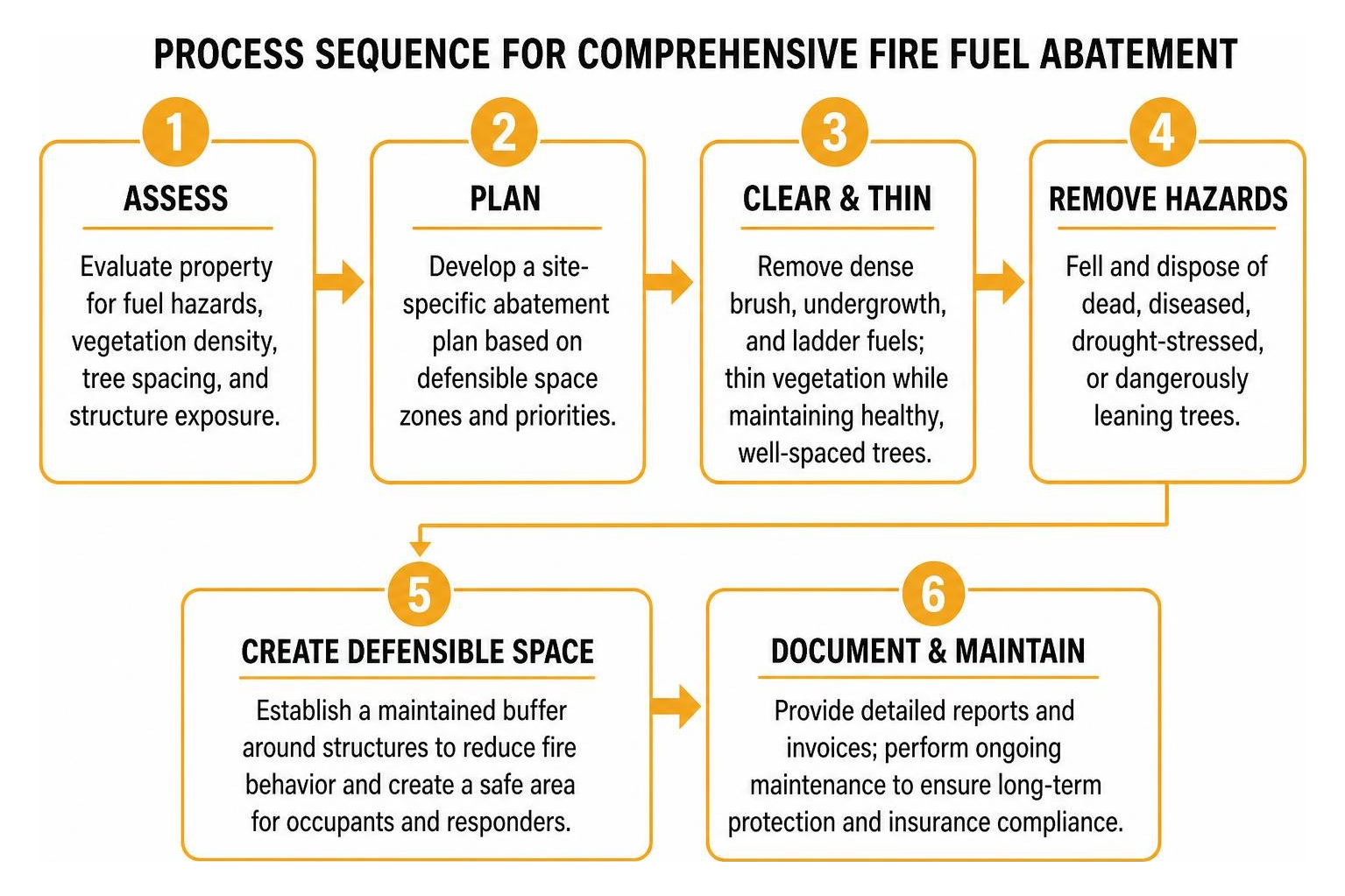
A full-scope mitigation project commonly incorporates:
- Brush Clearing and Mowing: Cutting back dense thickets of manzanita, chemise, scotch broom, and blackberry brambles to eliminate fast-burning ground fuels.
- Underbrush Thinning & Vegetation Management: Systematically removing overgrown native brush while preserving mature, healthy specimens with adequate horizontal spacing.
- Targeted Hazardous Tree Removal: Felling dead, diseased, drought-stressed, or dangerously leaning trees that threaten to collapse onto structures or act as massive fuel torches.
- Canopy Lifting and Limbing: Pruning lower tree branches 6 to 10 feet off the ground (or up to one-third of the tree’s total height) to prevent ground fires from climbing into the crowns.
- Weed Abatement: Cutting back annual grasses and fine fuels to a maximum height of 4 inches to slow flame spread across open fields.
- Specialized Tree Service Operations: Crown thinning to establish recommended horizontal separation between adjacent tree canopies.
Forestry Mulching vs. Traditional Land Clearing Methods
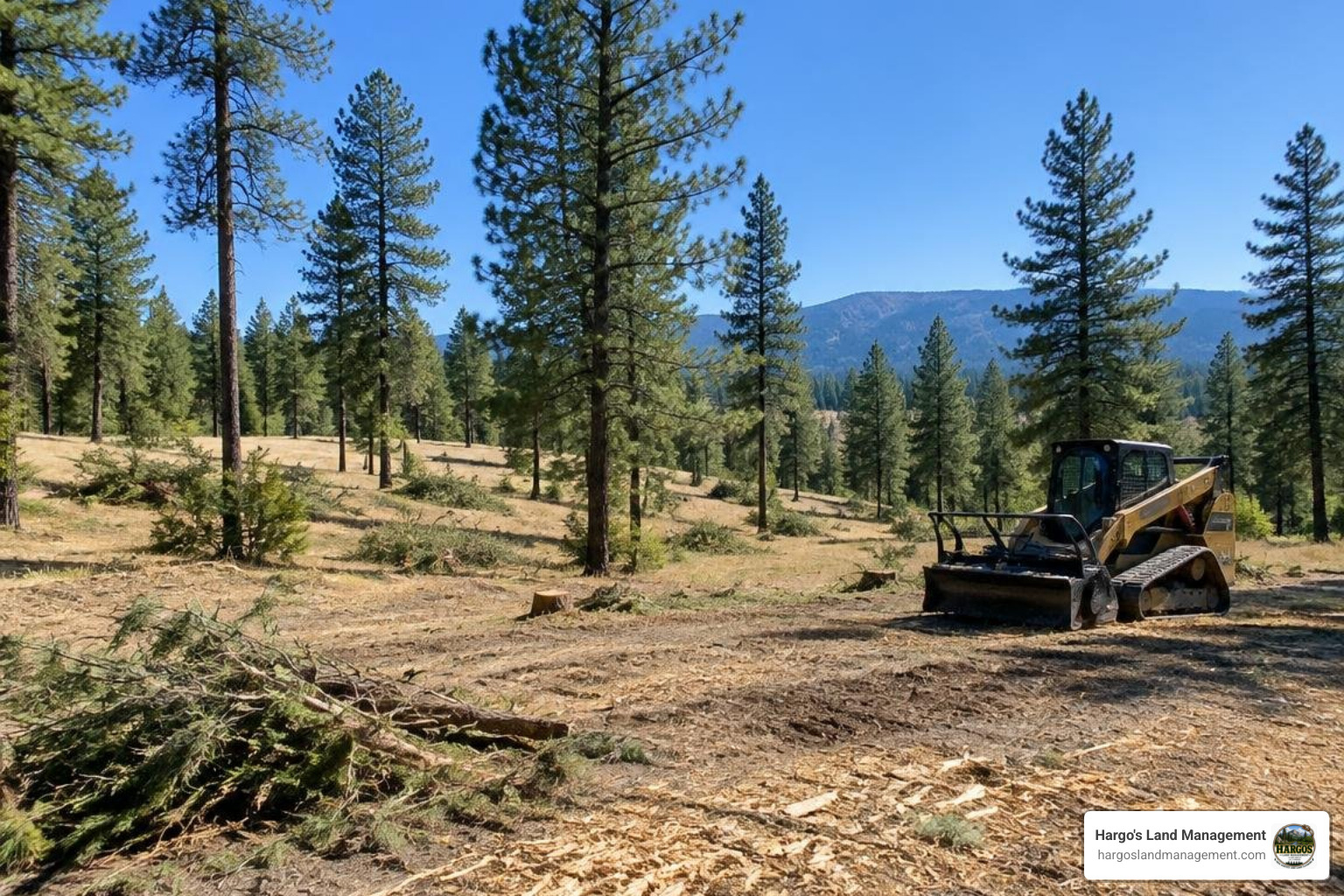
When property owners consider clearing dense brush, they often picture heavy bulldozers scraping the land down to bare dirt. While traditional land clearing has its place in structural construction, forestry mulching (mastication) has revolutionized wildfire fuel reduction.
| Feature / Metric | Forestry Mulching (Mastication) | Traditional Land Clearing (Scraping/Bulldozing) |
|---|---|---|
| Soil Impact | Minimal; leaves root systems intact | High; disrupts soil layers and increases erosion |
| Debris Handling | Shreds material into beneficial mulch on-site | Requires burn piles, site hauling, or disposal fees |
| Erosion Control | High; mulch blankets ground against rain runoff | Low; bare soil requires silt fencing and reseeding |
| Root Protection | Preserves root networks of remaining keeper trees | Can severe major roots and damage retained timber |
| Aesthetic Finish | Clean, park-like appearance immediately | Rough, rutted ground requiring grading |
| Environmental Footprint | Recycles organic matter back into topsoil | Disturbs native seed banks and causes compaction |
Forestry mulching utilizes high-performance rotary drums with carbide teeth attached to tracked or wheeled carriers. This equipment grinds standing trees, thick brush, and slash piles directly into a coarse layer of organic mulch.
This process avoids creating massive slash piles that pose severe fire hazards before they can be burned. It also prevents the topsoil loss and severe erosion risks that often follow aggressive scraping methods on steep hillsides.
Resolving Code Compliance Notices and HOA Violations
Failing to maintain compliant vegetation can quickly draw unwanted attention from local authorities. Fire protection districts, county code enforcement departments, and homeowners associations regularly inspect parcels in high-fire-severity zones. If your parcel has dead timber, unmanaged understory, or tall grasses, you may receive a formal violation notice with strict deadlines and looming monetary fines.
Whether facing California county fire mandates or local lot-clearing rules in other fire-vulnerable regions, prompt action is essential. Reputable contractors assess the specific citations, coordinate directly with code officers or HOA boards, and deploy the right equipment to bring the parcel back into full regulatory standing. Review our full range of property-clearing services to see how comprehensive lot maintenance eliminates these compliance headaches.
Finding the Best Defensible Space Clearing Near Me for Total Wildfire Defense
Selecting the right contractor to fire-harden your acreage requires careful vetting. Fire mitigation is a technical discipline that combines wildland fire dynamics, local forestry codes, and heavy machinery operation. You need an experienced team familiar with regional slope variations, native brush species, and soil conditions across our local service areas.

How to Choose Certified Defensible Space Clearing Near Me
To ensure your investment yields true safety and regulatory compliance, evaluate prospective land clearing contractors against these key standards:
- Licensing, Bonding, and Insurance: Verify that the company carries robust commercial liability and workers’ compensation policies. Tree work and mastication involve substantial mechanical force; never assume liability for uninsured operators.
- Fire-Safe Credentials: Look for evaluators and operators who have completed recognized coursework, such as training through the El Dorado County Fire Safe Council or state forestry programs.
- Specialized Low-Impact Equipment: The company should own modern masticators, compact track loaders, and chippers suited for steep, rocky foothill terrain without damaging keeper trees.
- Local Track Record: Ask for verified client references and review history. Hargo’s Land Management maintains a 4.9-star rating based on 71 customer reviews, reflecting over a decade of dedicated service since 2013.
What to Expect During Defensible Space Clearing Near Me Assessments
A reputable contractor will never quote a complex acreage clearing project over the phone without seeing the ground. A proper on-site evaluation ensures fair, transparent pricing and establishes an effective plan of attack.
During a standard on-site walkthrough, the evaluator will:
- Map Fuel Hazards: Inspect the immediate building perimeter, identifying combustible plants, dry debris accumulations, and overhanging limbs within the critical Zone 0 to Zone 1 perimeter.
- Evaluate Slope and Terrain: Steeper slopes cause wildfire flames to preheat uphill vegetation, requiring wider spacing between remaining tree clusters and brush patches.
- Establish Retained Tree Selection: Identify healthy native trees (such as mature oaks or healthy pines) to preserve, while marking suppressed, dead, or hazard trees for removal.
- Deliver a Transparent Written Proposal: Provide a clear scope of work outlining mechanical mastication, hand thinning, chipping, or hauling, with fixed project pricing rather than open-ended estimates.
- Set Realistic Execution Timelines: Define exact start dates and expected completion milestones based on site access and weather conditions.
To see how overgrown rural parcels transform into fire-resilient landscapes, check out our video defensible space before after transformations.
Frequently Asked Questions about Defensible Space Clearing
How long does a typical property clearing project take to complete?
The timeline for a defensible space project depends on several key variables:
- Total Acreage and Fuel Density: A standard 1-to-2-acre residential parcel with moderate brush typically takes 1 to 3 days. Larger 5-to-20-acre ranches or heavily overgrown parcels can take anywhere from 4 to 8 operational days.
- Slope and Access: Flat to gently rolling land allows masticators to move rapidly. Steep ravines, rocky drop-offs, or narrow access tracks require slower, careful equipment maneuvers and supplemental hand crews.
- Scope of Tree Work: Straightforward brush mastication moves quickly, whereas climbing, rigging, and dismantling massive dead ponderosa pines or oaks near rooflines adds time.
What specific clearance distances are required under local county regulations?
Most California counties, supported by CAL FIRE regulations, enforce three distinct defensible space zones extending up to 100 feet (or to the property line) from all structures:
- Zone 0 (Ember-Resistant Zone, 0–5 feet): The most critical zone immediately adjacent to the foundation. This area should be completely free of combustible mulches, dead leaves, stacked firewood, and flammable foundation plantings.
- Zone 1 (Lean, Clean, and Green Zone, 5–30 feet): All dead vegetation must be removed. Lawns must be mowed, tree canopies pruned to maintain a minimum 10-foot separation between crowns, and lower limbs lifted 6 to 10 feet from the ground.
- Zone 2 (Reduced Fuel Zone, 30–100 feet): Surface fuels must be reduced through mowing or mastication. Shrubs and trees must be spaced horizontally and vertically according to slope steepness to break up continuous fuel beds.
Can defensible space work prevent my homeowners insurance from being canceled?
While individual underwriting decisions rest with insurance carriers, completing professional fuel reduction is one of the most effective ways to protect your coverage. Many insurers now require proof of defensible space compliance prior to issuing or renewing policies in high-risk zones.
Providing your carrier with a formal contractor invoice, before-and-after photographic documentation, and an inspection sign-off from a certified evaluator demonstrates active risk reduction, making it significantly easier to secure policy renewals and retain competitive coverage.
Conclusion
Protecting your mountain or foothill home from wildfire requires proactive land management. Waiting until smoke appears on the horizon is too late to clear overgrown fuel ladders, thin crowded canopies, or remove hazardous dead timber. By establishing and maintaining clean, compliant buffer zones, you build a perimeter that protects your property, safeguards your family, satisfies insurance requirements, and gives firefighters the upper hand.
At Hargo’s Land Management, our licensed, bonded, and insured team combines local foothill experience with specialized mastication and tree-care equipment to deliver rapid, fire-focused results. Contact us today to schedule your comprehensive on-site property evaluation and take the first step toward lasting safety with professional defensible space clearing.
CUSTOMER REVIEWS & TESTIMONIALS
We strive to exceed your expectations. See what our customers have to say.













CONTACT US TODAY
Serving El Dorado and Surrounding Counties
Locally owned and operated since 2013. Use our live chat support to get in touch about your land management needs today.
Request a free evaluation and estimate by completing our online form or book an on-site appointment.
El Dorado County: El Dorado Hills, Cameron Park, Shingle Springs, Coloma, Placerville, Camino, Pollock Pines, South Lake Tahoe and more...
Amador County: Jackson, Ione, and Surrounding Towns
Sacramento County: Sacramento and Surrounding Cities
Placer County: Roseville, Rocklin, Auburn, and Everything In Between
Nevada County: Penn Valley, Nevada City, Grass Valley