
Arborvitae Tree Care: When to Fertilize, Water, and Protect
Arborvitae Tree Care Starts With Water and Drainage
To keep arborvitae healthy, plant them where they get about six hours of direct sun and have moist, well-drained soil. Water new trees deeply two or three times a week for the first few months, adjusting for rain and soil moisture. Once established, water during dry spells. Mulch around the roots, fertilize in early spring only if needed, and trim lightly without cutting into bare wood.
Before winter, water if fall has been dry and protect exposed trees from wind, heavy snow, and deer. The guide below covers each step, plus what to check when foliage turns brown.
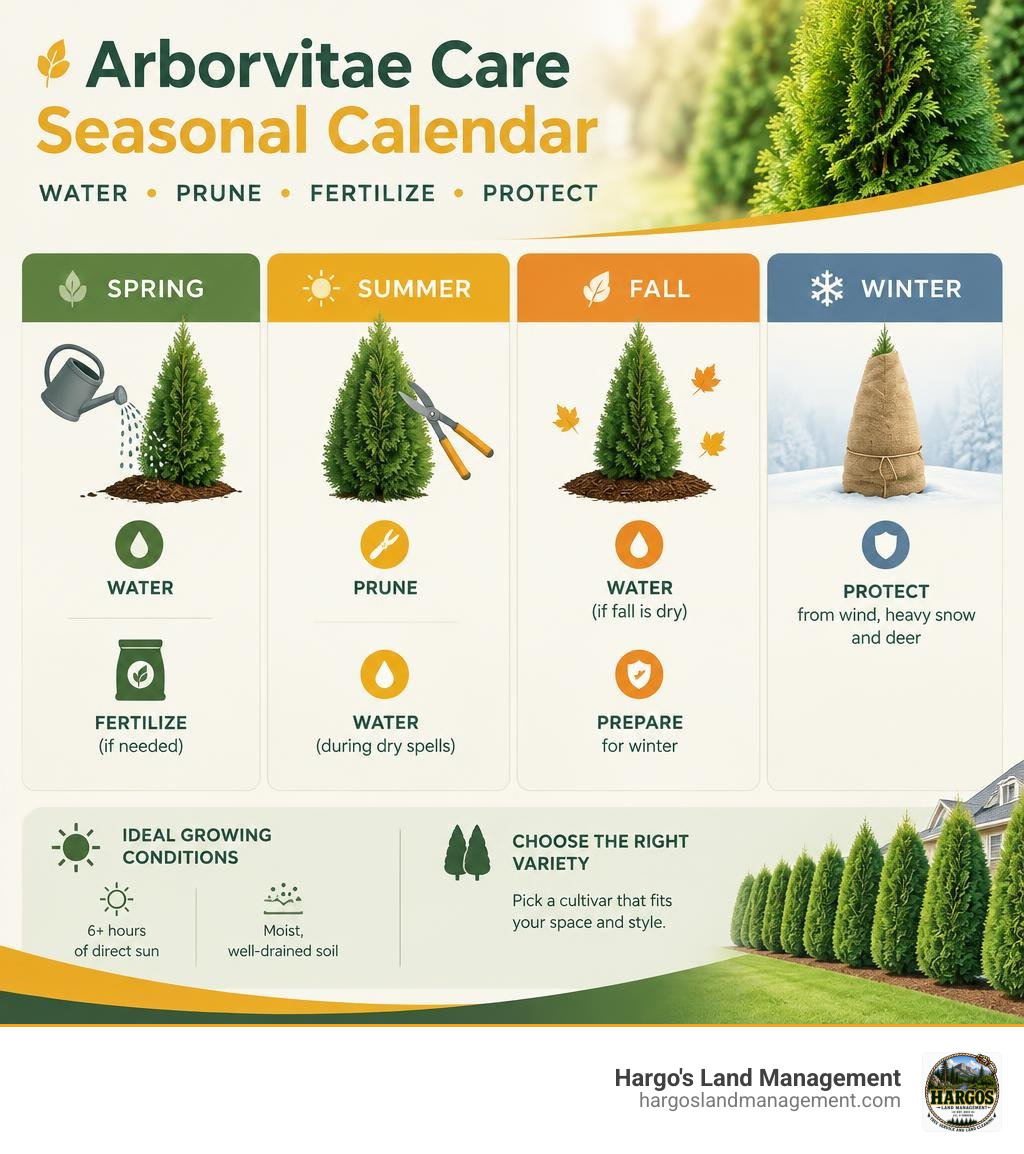
Optimal Growing Conditions and Variety Selection
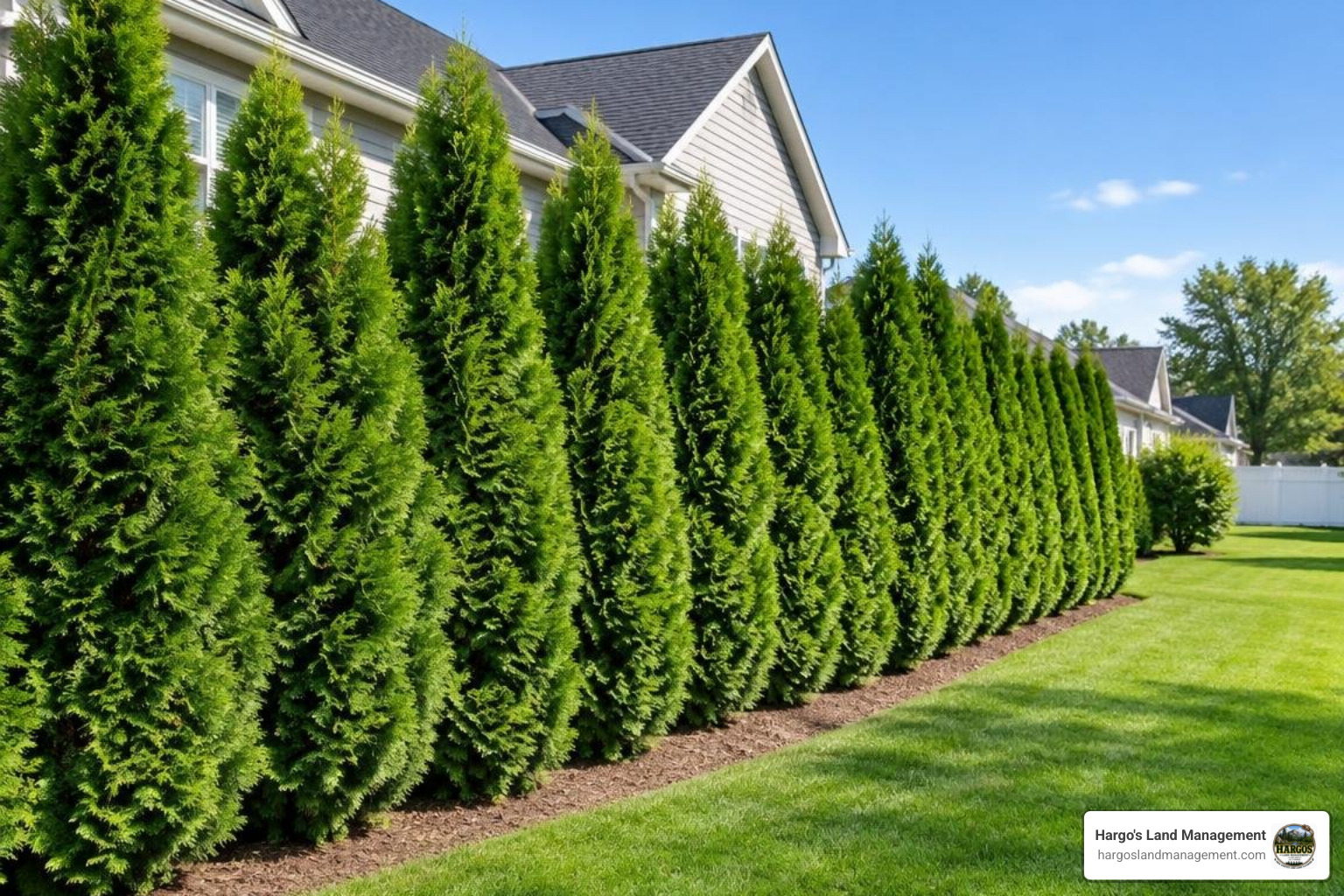
Arborvitae (Thuja species) are among the most dependable evergreen conifers in North America. Known colloquially as the “Tree of Life”—a name coined when early explorers used the vitamin C–rich foliage to treat scurvy—these structural marvels offer dense screening, wind protection, and rich green coloration throughout the year.
However, arborvitae are not completely self-sustaining. Achieving rapid growth and preventing dieback requires meeting their environmental preferences. Most varieties flourish across USDA Hardiness Zones 3 through 8 (with some hybrids performing well up into Zone 9). They prefer moist, rich, well-drained loams with a soil pH between 6.0 and 8.0, though they can tolerate a broader range from 5.0 to 8.0.
While they can tolerate light partial shade, arborvitae need at least six hours of direct sunlight daily to maintain full, compact foliage from top to bottom. Planting them in overly dense shade causes their canopies to thin and drop lower branches. Furthermore, while they love consistently moist soil, their root systems suffocate in standing water. Reviewing the OSU Extension guidelines on planting arborvitae reinforces that good drainage is non-negotiable for root survival.
| Variety | Growth Rate (per year) | Mature Height | Mature Spread | USDA Zones | Best Landscape Use |
|---|---|---|---|---|---|
| Thuja ‘Green Giant’ | 3 to 5 feet | 40 to 60 feet | 12 to 18 feet | 5–9 | Large privacy screens, windbreaks |
| Emerald Green (Smaragd) | 6 to 9 inches | 8 to 12 feet | 3 to 4 feet | 3–8 | Narrow hedges, small urban yards |
| American Arborvitae (T. occidentalis) | 1 to 2 feet | 40 to 60 feet | 10 to 15 feet | 3–7 | Native woodland borders, large boundaries |
| Techny (Mission) | 1 to 2 feet | 15 to 20 feet | 6 to 8 feet | 3–8 | Extreme cold zones, medium hedges |
| North Pole | 12 to 18 inches | 10 to 15 feet | 3 to 5 feet | 3–7 | Tight columnar accent, narrow borders |
Selecting the Right Cultivar for Your Landscape
Choosing the correct cultivar ensures your hedge fits your property dimensions without demanding constant, aggressive pruning down the road. If you have a spacious boundary and need fast visual isolation, hybrid powerhouses like the Thuja standishii x plicata ‘Green Giant’ are ideal. This hybrid surges upward at an astonishing rate of 3 to 5 feet per year under ideal conditions, making it a favorite for homeowners seeking immediate privacy. To understand how it compares with other fast growers, check out the Planting Atlas guide on fast-growing privacy trees.
For smaller suburban lots or tight corridors near property boundaries, ‘Emerald Green’ (Thuja occidentalis ‘Smaragd’) is the gold standard. It features a slower, tidy growth rate of 6 to 9 inches per year and tops out at a manageable 8 to 12 feet tall and 3 to 4 feet wide. Western red cedar (Thuja plicata) cultivars, on the other hand, offer superior performance in cooler maritime climates and provide better natural resistance to deer than standard American arborvitae.
Soil, Sun, and Spacing Essentials
Before digging, evaluate your site’s drainage. You can perform a simple soil drainage test: dig a hole 12 inches deep and 12 inches wide, fill it with water, let it drain completely, fill it again, and time how quickly the water recedes. A drainage rate of roughly 1 inch per hour indicates prime conditions. If your soil drains much slower, you are dealing with dense clay that will hold excess water around roots; consider planting on raised berms to prevent root rot.
When installing arborvitae, dig the planting hole twice to three times as wide as the root ball, but no deeper. Position the tree so the root flare—the point where the trunk widens at the base—sits 1 to 2 inches above the surrounding grade. Setting the root ball too deep suffocates the shallow root system and invites trunk rot.
Proper spacing depends directly on the cultivar’s mature spread:
- Narrow hedges (e.g., Emerald Green): Space plants 3 to 4 feet apart on center.
- Large privacy screens (e.g., Green Giant): Space single rows 5 to 8 feet apart. For a fast, impenetrable wall, plant a staggered double row with trees spaced 8 feet apart within each row and 6 to 8 feet between rows.
Essential Seasonal Arborvitae Tree Care: Fertilizing, Watering, and Soil Health
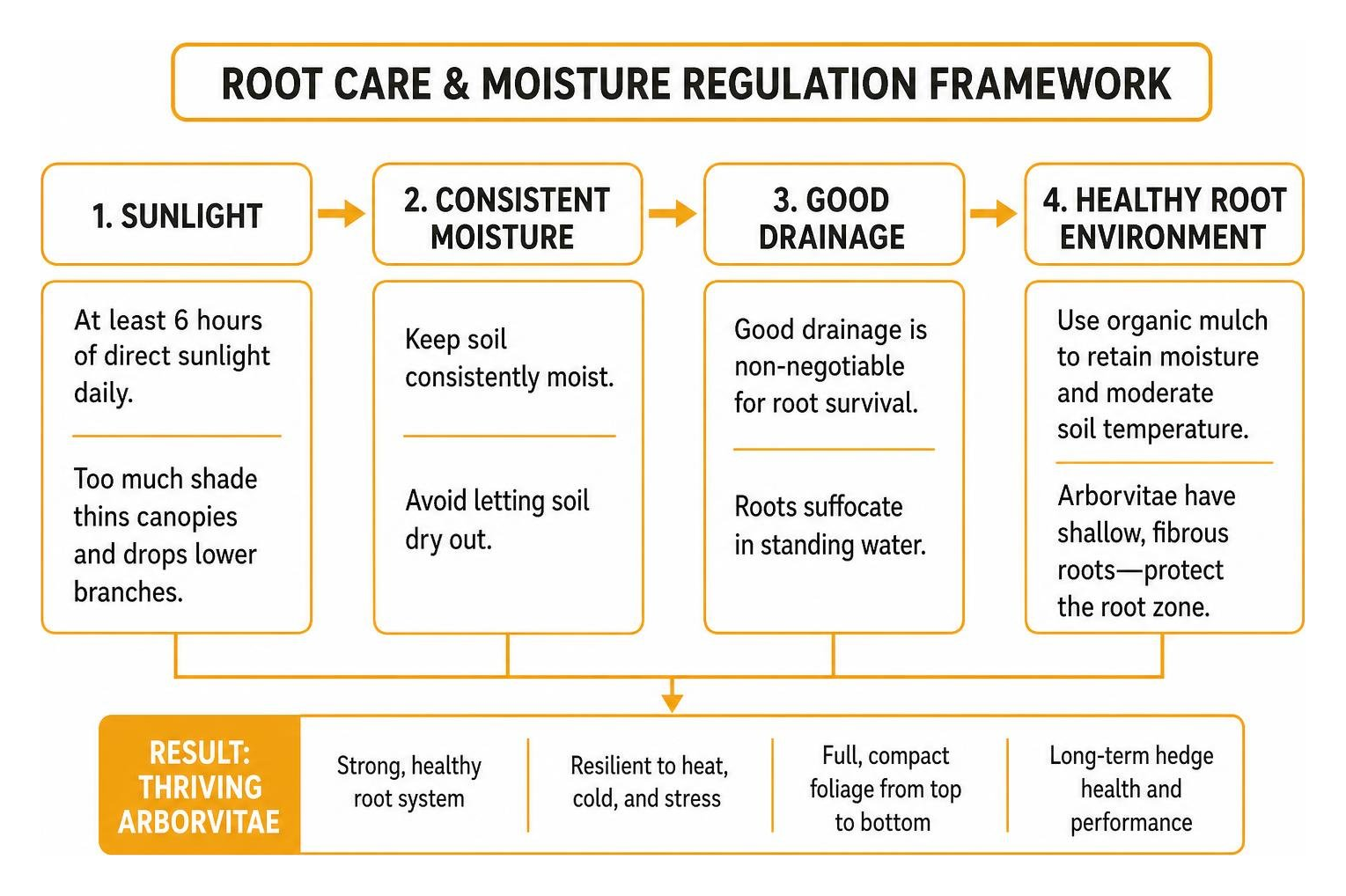
A thriving arborvitae hedge relies on consistent soil moisture, adequate organic mulch, and conservative feeding. Because arborvitae possess relatively shallow, fibrous root systems, they are particularly susceptible to rapid moisture loss and surface soil temperature swings.
Newly Planted vs. Established Arborvitae Tree Care and Watering Schedules
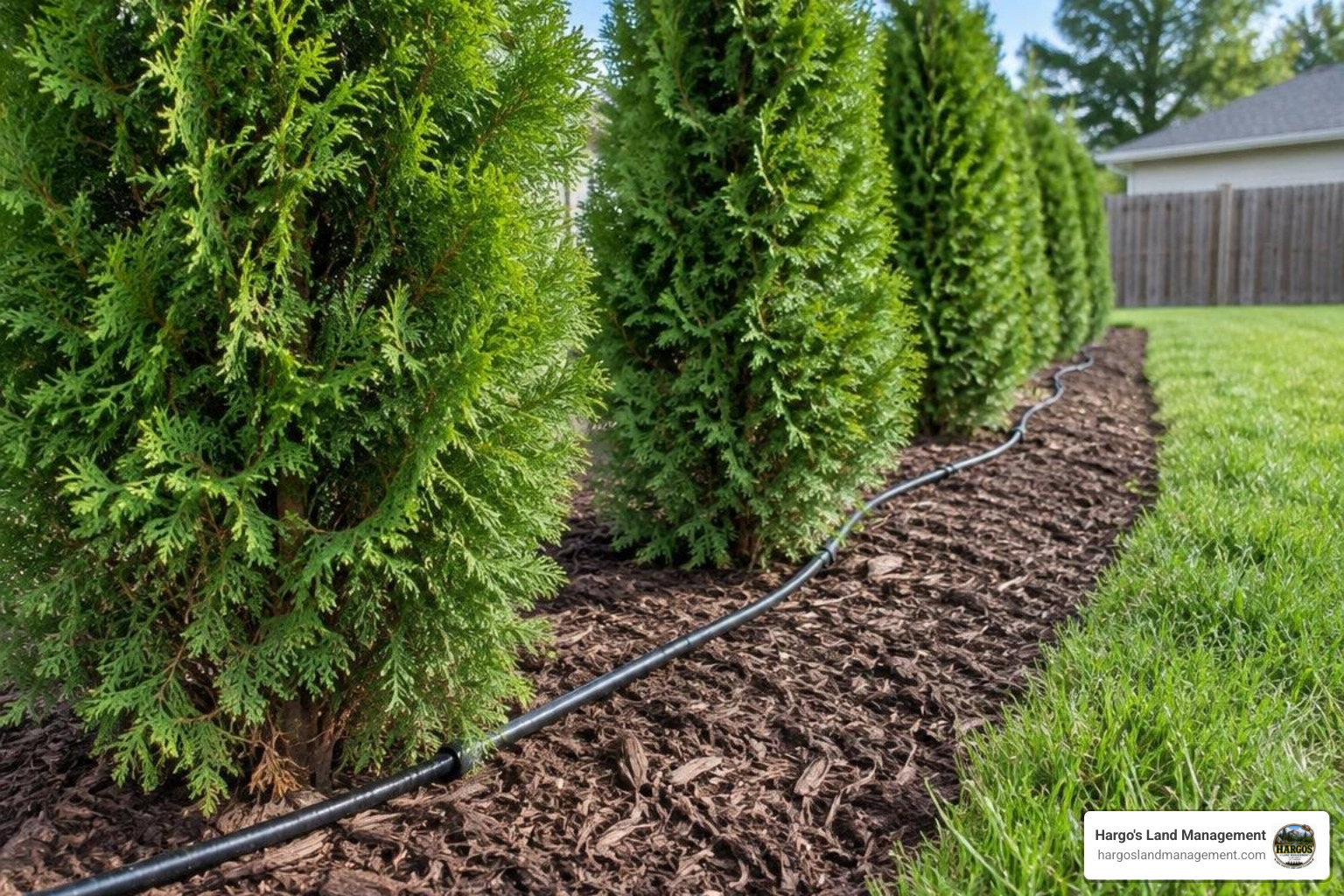
Watering management is the single most critical factor in establishing young trees. Arborvitae are not drought-tolerant, and transplant shock quickly leads to desiccated, brittle foliage.
- Newly Planted Trees (Weeks 1 to 4): Water deeply 2 to 3 times a week. If using a slow-drip irrigation system or soaker hose, provide a slow, steady soak for 2 to 4 hours per session, ensuring moisture penetrates deep into the root ball.
- Establishment Period (Months 2 to 12): Taper watering to once or twice weekly during warm, dry periods. Focus on delivering 1 to 2 inches of water per week, factoring in natural rainfall.
- Established Trees (Year 2 and Beyond): Established arborvitae require supplemental watering during dry spells and heat waves. A deep soaking every 10 to 14 days during hot, rain-free summer months keeps the root zone resilient and prevents canopy browning.
Always avoid overhead sprinklers that wet the foliage during hot afternoons, as lingering canopy moisture promotes fungal needle blights. Apply water directly to the soil surface around the root perimeter.
Fertilization Timing and Soil Amendments
Arborvitae are modest feeders. In most residential yards with decent soil, they require supplemental fertilizer only once a year, preferably in early spring just as new growth begins.
Use a balanced, slow-release granular fertilizer formulated for evergreens (such as a 10-10-10 or 14-14-14 NPK formulation) or an organic plant food. Distribute the granules evenly around the drip line of the tree and water thoroughly. Never apply high-nitrogen fertilizers in late summer or fall. Late-season nitrogen applications force a flush of tender, succulent green growth that will not harden off before freezing temperatures arrive, leading to extensive winterkill.
Top-dressing the root zone with a 2- to 3-inch layer of organic mulch helps maintain consistent soil moisture, stabilizes soil temperatures, and adds organic material as it decomposes. Homeowners can take advantage of free wood chips to create a wide protective mulch ring around their hedges. Always leave a 3-inch gap between the mulch and the tree trunk to prevent fungal disease and rodent nesting.
Winter Arborvitae Tree Care: Preventing Snow Split, Windburn, and Deer Damage
Winter is often the most demanding season for evergreen hedges. Cold winter winds strip moisture from foliage faster than frozen root systems can replenish it, resulting in unsightly “winter burn.” Heavy snow loads can also splay multi-stemmed cultivars, snapping structural branches.
To protect your trees through harsh winters:
- Hydrate Deeply in Late Autumn: Give your trees several deep soakings before the ground freezes solid. An evergreen entering winter fully hydrated is substantially less vulnerable to desiccation.
- Erect Windbreaks: For trees exposed to fierce, prevailing winter winds or road salt spray, construct a burlap screen on the windward side. Drive wooden stakes into the ground and attach the burlap, creating a barrier without wrapping the fabric tightly against the foliage.
- Secure Multi-Leader Tops: Cultivars with multiple vertical stems (like Emerald Green) can be loosely tied together using wide, flexible arbor tie or soft twine to prevent heavy, wet snow from splitting the branches outward.
- Brush Snow Gently: After heavy snowfalls, use an upward sweeping broom motion to dislodge snow gently. Never shake frozen branches violently, as brittle wood snaps easily. If a severe storm damages your landscape, prompt storm cleanup helps clear hazardous limbs and salvage damaged specimens.
- Deter Hungry Deer: Arborvitae, particularly native American varieties, are a favorite winter food source for deer. Protect young trees by installing sturdy 8-foot deer fencing or applying commercial taste and scent repellents starting in early autumn, reapplying regularly according to label instructions.
Pruning Techniques, Hedging, and Structural Management
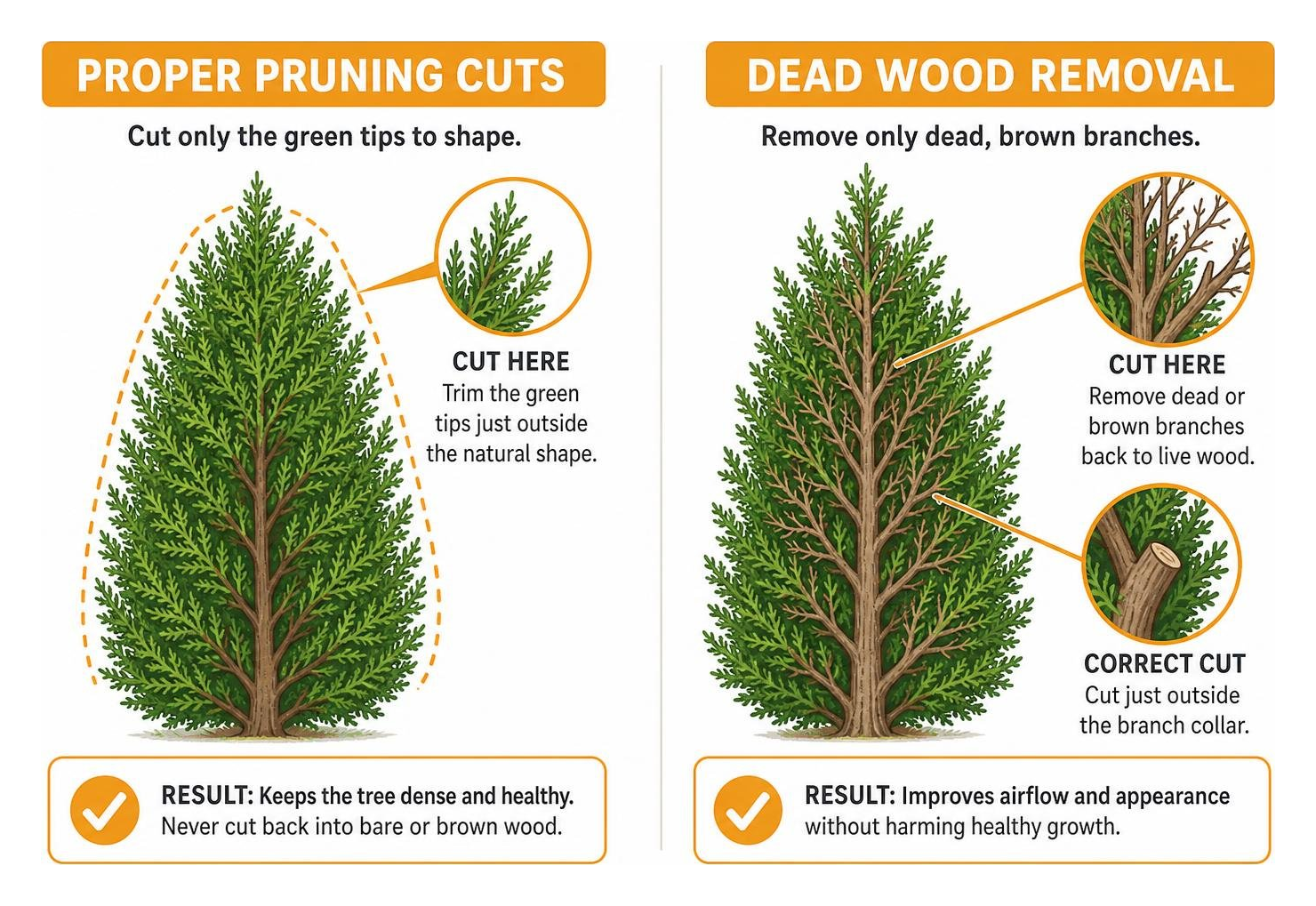
Pruning arborvitae requires a conservative touch. Unlike broadleaf trees and certain deciduous shrubs, arborvitae cannot regenerate foliage from old, bare wood. Inside every dense arborvitae canopy lies a natural “dead zone”—an interior area devoid of green needles due to shading. If you prune back past the outer green shell into this leafless interior wood, that bare spot will remain permanently bare.
Proper Trimming Schedules and Hedging Methods
When pruning, follow a structured seasonal schedule:
- Late Winter to Early Spring (Dormant Pruning): This is the ideal window for light structural shaping and removing winter-damaged or broken branches before new growth starts.
- Late Spring to Early Summer (Maintenance Shearing): Once the spring flush of new growth emerges, lightly shear the outer perimeter to tidy up hedge lines and encourage tighter canopy density.
Never remove more than one-quarter of the total green canopy in a single growing season. Always prune hedges so the base of the plant remains slightly wider than the top (a subtle pyramidal or trapezoidal profile). This allows sunlight to reach the lower branches, preventing the bottom of your privacy hedge from thinning out over time. If your hedge has grown unwieldy or requires extensive structural correction, scheduling an ISA Certified Arborist ensures your trees receive safe, professional care.
Can You Cut the Top Off an Arborvitae?
Cutting the top off an arborvitae—commonly called “topping”—is one of the most damaging mistakes a property owner can make. Homeowners often resort to topping when a tree outgrows its location, but the practice causes irreversible structural problems.
When you cut through the main vertical leader:
- You destroy the tree’s natural conical form: The flat, decapitated top leaves an exposed, flat surface where snow, ice, and fungal spores accumulate.
- You stimulate weak, competing leaders: The tree responds by pushing multiple vertical shoots from lateral buds beneath the cut. These secondary leaders develop weak branch attachments with included bark, making the top of the tree highly prone to tearing out during wind and ice storms.
- You create permanent dead gaps: If you cut into thick, mature wood below the active green growth line, the top will remain a bare stump that never greens over.
Before altering tree height, review the risks detailed in tree topping service risks vs safe structural pruning. According to Penn State Extension research on arborvitae health, maintaining a single, unified central leader provides the greatest defense against snow loading, ice splitting, and premature decline.
Troubleshooting Arborvitae Problems: Browning, Pests, and Diseases
Discovering brown foliage on an arborvitae hedge can be alarming, but not all browning signals catastrophic decline. Correct diagnosis is key to targeted recovery.
Why Is My Arborvitae Turning Brown?
- Interior Needle Shedding (Normal Fall Phenomenon): In mid-to-late autumn, 3- to 5-year-old needles located deep inside the canopy turn yellow, then brown, and naturally drop off. As long as the outer tips and outer canopy remain vibrant green, this is simply the tree shedding unproductive interior foliage.
- Winter Bronzing: During cold snaps, some cultivars (particularly standard American arborvitae) take on a dull, bronze or brownish cast. This is a natural protective reaction to cold and solar radiation. The rich green color returns rapidly once temperatures warm in spring.
- Drought Stress vs. Overwatering: Underwatered arborvitae turn dry, dull, and crispy, beginning at the branch tips and progressing inward. Conversely, overwatered trees suffering from root rot show wilting, yellowing, and dull gray-brown foliage that easily pulls away from waterlogged, foul-smelling roots.
- De-icing Salt Damage: If the side of your hedge facing a road or driveway turns uniform brown in early spring, road salt spray or runoff is likely the cause. Thoroughly flush the soil with fresh water in spring to dilute accumulated salts.
Identifying and Managing Common Pests and Fungal Diseases
- Bagworms (Thyridopteryx ephemeraeformis): These destructive caterpillars construct 1.5- to 2-inch spindle-shaped bags out of silk and arborvitae foliage. They feed voraciously from late spring through summer, rapidly stripping branches bare. Hand-pick and destroy the bags during fall and winter. For active spring infestations, apply Bacillus thuringiensis (Bt) or spinosad when the larvae are small.
- Spider Mites: Thriving in hot, dry, dusty conditions, these microscopic pests pierce needles and suck sap, causing foliage to take on a stippled, dusty, grayish-yellow appearance. Check for mites by shaking a branch over a white sheet of paper. Wash off light infestations with strong streams of water or apply insecticidal soap and horticultural oils according to the Gardener’s Path arborvitae pest management advice.
- Tip Blight (Kabatina and Pestalotiopsis): Fungal blights attack branch tips, turning them yellow and then ash-gray. Prune out infected twigs during dry weather, sterilizing pruners with 70% isopropyl alcohol between cuts, and avoid overhead irrigation.
- Seiridium Cankers: These fungal cankers cause sunken, oozing lesions on stems, cutting off water supply and causing entire individual branches to die (“flagging”). Prune affected branches several inches below the canker into healthy wood.
When extensive structural decay, severe root rot, or heavy storm damage leaves a tree dead and structurally compromised, assessing the specimen for hazardous tree removal protects surrounding structures and keeps your landscape safe.
Frequently Asked Questions About Arborvitae Trees
How fast do arborvitae trees grow each year?
Growth rates vary significantly across cultivars and site conditions. Hybrid cultivars like Green Giant can grow 3 to 5 feet per year under full sun, consistent moisture, and fertile soil. Standard American arborvitae grows at a moderate pace of 1 to 2 feet annually, while compact cultivars like Emerald Green grow slowly at just 6 to 9 inches per year.
How far apart should arborvitae be planted for a privacy hedge?
Spacing depends on the variety’s mature width:
- Emerald Green: Plant 3 to 4 feet apart on center for a dense, continuous wall.
- Green Giant: Plant 5 to 6 feet apart for an ultra-dense hedge, or 8 feet apart for a natural windbreak. Alternatively, space them 8 feet apart in staggered double rows spaced 6 feet apart.
- American Arborvitae: Plant 4 to 6 feet apart on center.
Can an arborvitae recover from severe browning?
It depends on whether the underlying wood is dead or alive. Perform a simple scratch test: gently scrape the outer bark of a brown twig with your thumbnail. If you see moist, green cambium tissue beneath, the branch is alive and may push new growth from surviving buds. If the wood is brittle, dry, and brown all the way through, that branch is dead and must be pruned out. If more than 50% of the tree’s outer canopy is dead to the inner wood, complete replacement is often more practical than waiting for recovery.
Conclusion
A well-maintained arborvitae hedge offers unmatched year-round beauty, reliable privacy, and essential wind protection. By providing at least six hours of sun, ensuring well-drained soil, practicing deep and consistent watering, and avoiding improper topping cuts, you can keep your evergreen hedge lush and vigorous for decades.
At Hargo’s Land Management, we help property owners protect their landscape investments and maintain defensible space against regional wildfire hazards. Whether you need expert hedge shaping, storm hazard assessments, or complete land management solutions, learn how our team helps maintain healthy trees across Placerville, Auburn, and Lake Tahoe. Contact us today to schedule your comprehensive tree service consultation and keep your property vibrant, safe, and beautiful.
CUSTOMER REVIEWS & TESTIMONIALS
We strive to exceed your expectations. See what our customers have to say.



















CONTACT US TODAY
Serving El Dorado and Surrounding Counties
Locally owned and operated since 2013. Use our live chat support to get in touch about your land management needs today.
Request a free evaluation and estimate by completing our online form or book an on-site appointment.
El Dorado County: El Dorado Hills, Cameron Park, Shingle Springs, Coloma, Placerville, Camino, Pollock Pines, South Lake Tahoe and more...
Amador County: Jackson, Ione, and Surrounding Towns
Sacramento County: Sacramento and Surrounding Cities
Placer County: Roseville, Rocklin, Auburn, and Everything In Between
Nevada County: Penn Valley, Nevada City, Grass Valley