
Beginner’s Guide to Effective Weed Control Methods
Weed Control Starts With Prevention
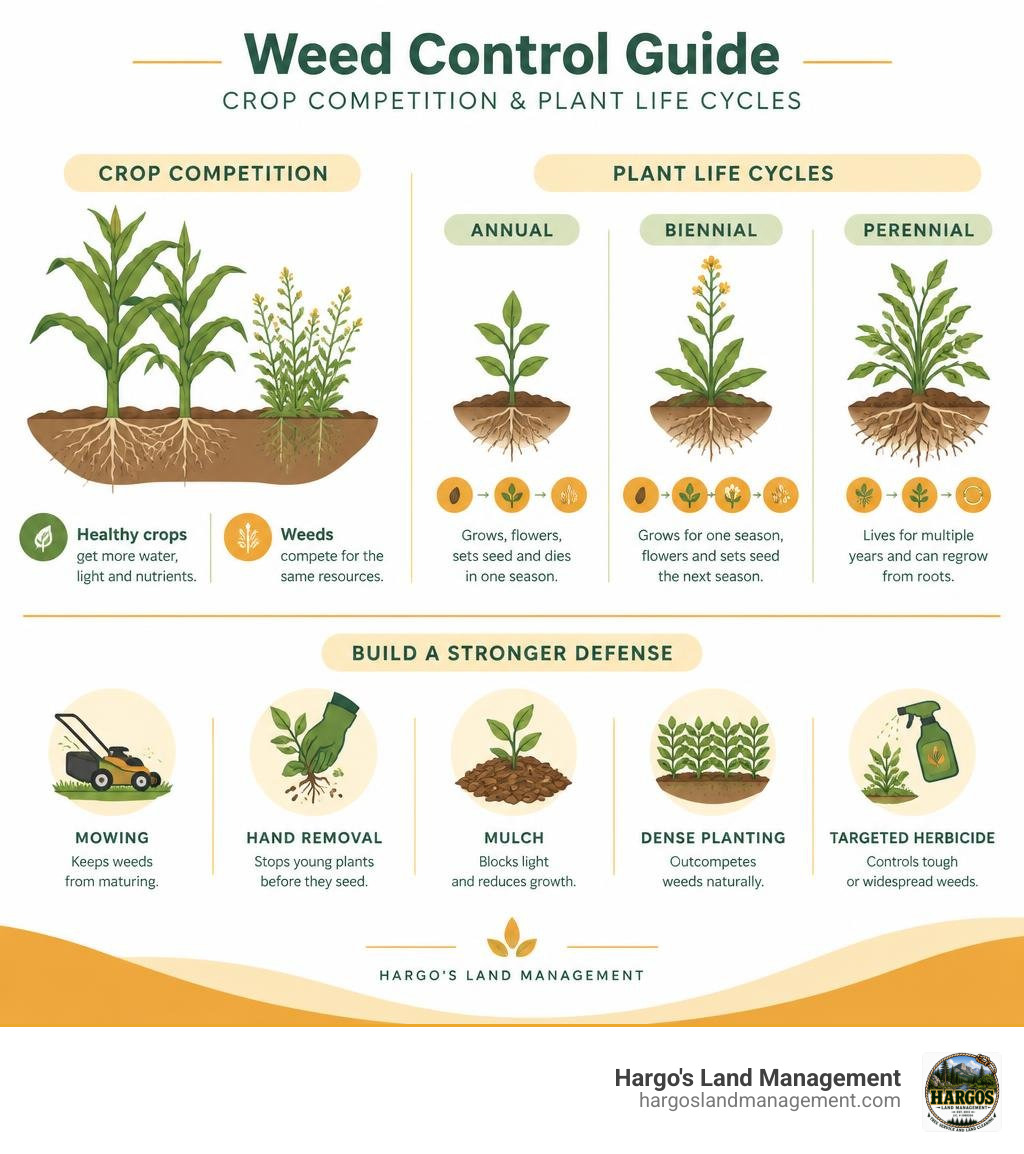
Effective weed control means stopping weeds before they spread, removing young plants before they set seed, and keeping desirable plants healthy enough to compete. Start by identifying the weeds on your property. Then choose the right mix of mowing, hand removal, mulch, dense planting, or targeted herbicide use. Check the area again for new growth.
On a large property, this work does more than protect a garden or pasture. Weeds can take water, light, and nutrients from wanted plants. Dry, overgrown vegetation can also add fuel near a home during wildfire season. The best plan tackles both the weeds you can see and the seeds or roots that may bring them back.
Understanding Weed Biology and Life Cycles
To beat weeds, we have to understand how they live, reproduce, and survive adverse conditions. At its core, a weed is simply any plant growing where it is not wanted. However, invasive and competitive weeds possess distinct biological advantages over native plants and cultivated crops.
Weeds often grow twice as fast as desirable turfgrass or agricultural crops. They steal crucial soil moisture, sunlight, nitrogen, and oxygen. In farming systems, weed competition can trigger drastic losses; agricultural studies demonstrate that once uncontrolled weed competition begins, crop yields such as onion bulbs can drop by nearly 4% per day. In natural settings and rangelands, aggressive species like spotted knapweed can reduce desirable forage grasses on wildlife winter range by up to 90%.
A major challenge in weed management is the “seed bank”—the reservoir of viable dormant seeds resting below the soil surface. Consider these biological facts:
- Groundsel can produce roughly 1,000 seeds per plant, while Scentless Mayweed yields over 30,000 seeds per plant.
- Common mullein can release up to 223,200 seeds in a single lifecycle.
- Dock seeds remain viable in the soil for 50 years or more, and common poppy seeds can lie dormant for 80 to 100 years, waiting for sunlight before germinating.
- Species such as couch grass release allelopathic biochemicals into the dirt, directly suppressing the root development of surrounding desirable vegetation.
According to Colorado State University research on weed management, identifying a plant’s specific growth habit is vital for selecting control methods:
| Lifecycle Class | Lifespan | Primary Method of Reproduction | Root Structure | Vulnerability Window | Common Examples |
|---|---|---|---|---|---|
| Annual | 1 season (Winter or Summer) | Prolific seed production | Shallow taproots or fibrous clusters | Seedling stage before flowering or setting seed | Crabgrass, Chickweed, Groundsel, Pigweed |
| Biennial | 2 seasons (Vegetative year 1, Seed year 2) | Seed production in the second year | Fleshy taproot | First-year vegetative rosette stage | Bull Thistle, Houndstongue, Common Mullein |
| Perennial | 3+ years (Indefinite lifespan) | Seeds, creeping rootstocks, rhizomes, stolons, tubers | Deep extensive taproots or underground networks | Seedling stage or fall carbohydrate storage period | Dandelion, Field Bindweed, Canada Thistle, Quackgrass |
Annual and Biennial Weed Dynamics
Annual weeds complete their entire cycle within twelve months. Summer annuals germinate in spring, grow during summer, drop seed in late summer or autumn, and die at first frost. Winter annuals germinate in late summer or autumn, overwinter as small rosettes, flower in early spring, and disperse seeds before dying in summer heat.
Biennial weeds spend their entire first year growing low-profile vegetative rosettes and establishing nutrient reserves in deep taproots. During their second year, they bolt, produce flowering stalks, cast thousands of seeds, and perish.
Because annuals and biennials rely heavily on seed production to persist, the best strategy is stopping them before they flower. Regular mowing, string trimming, or shallow hoeing before bud break depletes the seed bank over time. For non-toxic home settings, the University of Maryland Extension guide on non-chemical weed management highlights how shallow cultivation cuts annual weeds at the root crown without churning dormant buried seeds to the surface.
Perennial Weeds and Deep Root Systems
Perennials represent a more complex management challenge. They do not rely solely on seeds; they reproduce and spread through persistent underground root systems, including rhizomes, tubers, creeping rootstocks, and bulbs.
When a gardener or property owner pulls a perennial weed and snaps the root, remaining underground fragments readily regenerate new shoots. Throughout the spring and summer, perennials draw on stored carbohydrates to push leafy growth upward. In late summer and autumn, they reverse this flow, translocating sugars deep into their root networks for winter dormancy.
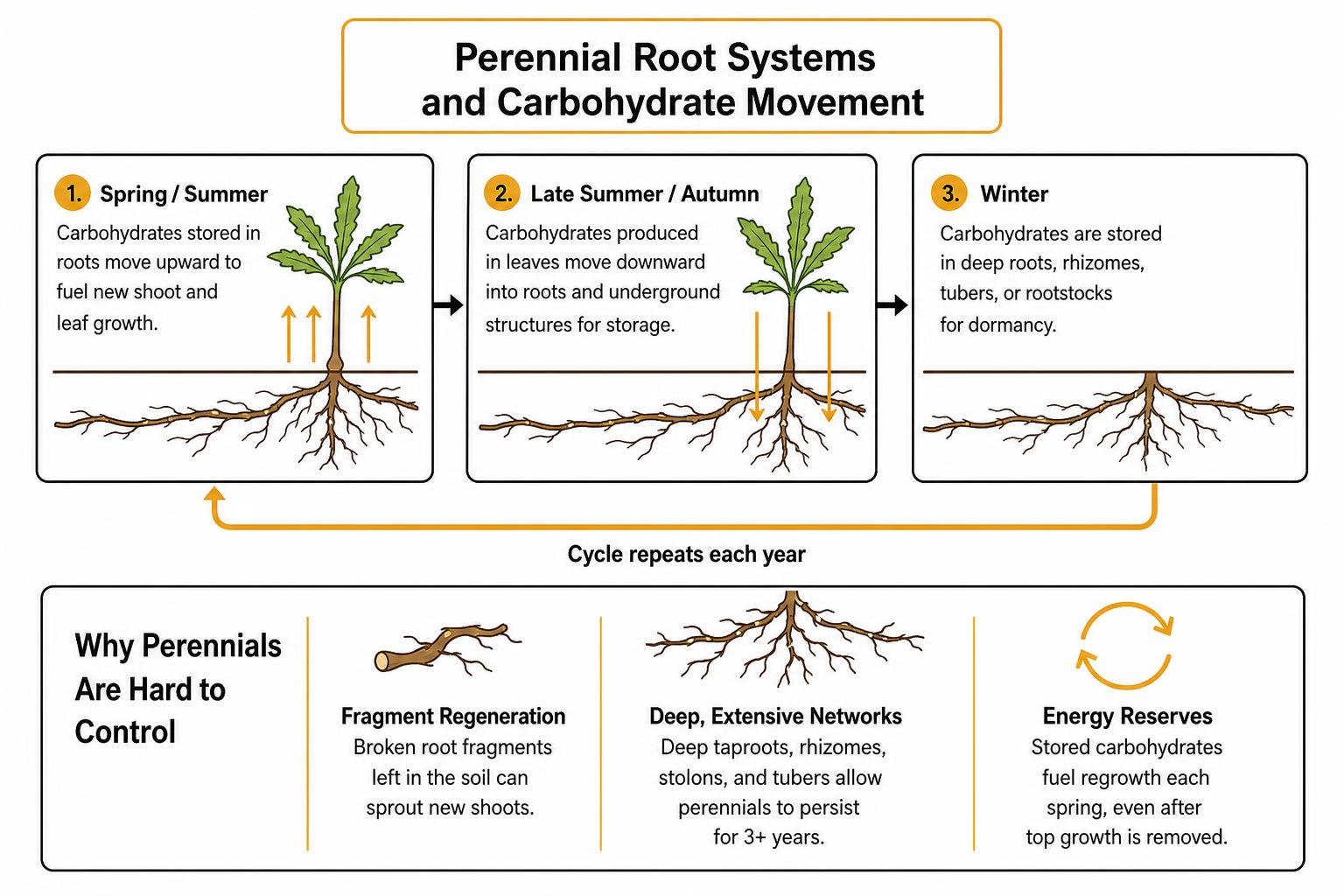
Overcoming deep-rooted perennials requires sustained suppression to exhaust their energy reserves, complete physical extraction, or timed systemic treatments. When pastures or rangelands become overrun with woody brush and persistent perennial thickets, transforming overgrown acreage into usable ground requires a structured multi-stage reclamation plan.
The Core Methods of Weed Control

Modern weed management combines physical, cultural, biological, and chemical methods. Relying on a single control tool can lead to weed escapes, herbicide resistance, or wasted expense. The cost of managing weeds ranges from $10 to over $350 per acre, depending on terrain, weed density, equipment accessibility, and selected techniques.
For residential spaces, the Utah State University guide on residential lawn weed options points out that a thick, healthy stand of desirable grass is always the primary line of defense. The sections below explore the four primary pillars of weed management.
Physical and Mechanical Tactics
Mechanical control uses physical tools to remove, sever, smother, or desiccate weed growth:
- Hand-Weeding and Hoeing: Best for residential garden beds and minor infestations. Hand pulling is most effective when the soil is damp following rain or irrigation, allowing the entire root structure to slide out intact. Using an oscillating or hula hoe at a 45-degree angle slices shallow weed seedlings without disturbing the deeper soil profile.
- Scheduled Mowing: Cutting weeds before they set buds eliminates seed production. For turf, maintaining a mowing height between 2.5 and 4 inches shades the soil surface, cooling the ground and blocking the sunlight needed for weed seed germination.
- Soil Solarization and Occultation: Solarization involves laying clear polyethylene plastic tightly over moist, cultivated ground during peak summer heat for 4 to 6 weeks. Trapped solar heat pushes upper soil temperatures past 140°F, killing most weed seeds and soil-borne pathogens. Occultation (tarping) uses heavy, UV-stabilized black silage tarps for 4 weeks to several months to block sunlight, depleting weed seed reserves through continuous darkness.
- Sheet Mulching: Also called “lasagna mulching,” this non-chemical method layers thick, unwaxed corrugated cardboard directly over cleared weeds, followed by 3 to 4 inches of organic material (wood chips, compost, arbor mulch). It smothers existing weeds while enriching soil structure as the carbon breaks down.
- Heavy Mechanical Clearing: On rough rural properties, high-density infestations of invasive brush, blackberries, and scrub require specialized heavy brush clearing equipment like forestry mulchers, flail mowers, and masticators to clear fuels and eliminate mature woody seed heads.
Cultural and Biological Controls
Cultural practices alter the growing environment to favor desirable plants over weed species, while biological controls use living organisms to suppress weed populations:
- Irrigation Management: Overhead broadcast sprinklers wet the entire surface, feeding weed seeds in unplanted areas. Transitioning to drip irrigation applies water only to root zones of desirable plants, leaving surrounding soil dry to inhibit weed germination.
- Cover Cropping and Dense Planting: Seeding fast-growing cover crops like cereal rye, clover, or hairy vetch smothers weeds and protects soil between planting cycles. In garden borders, dense canopy plantings intercept light before it hits weed seeds on the soil surface.
- Targeted Grazing: Goats and sheep serve as biological controls across rangelands and steep terrain. Goats prefer woody broadleaf plants and rough invasive weeds (such as leafy spurge, knapweed, and poison oak) over tender grasses, stripping foliage and starving the root systems without causing soil compaction.
- Biocontrol Insects: Government agricultural agencies introduce host-specific biological control insects that feed exclusively on targeted non-native weeds without harming native flora. Examples include flea beetles (Aphthona species) released to control leafy spurge or Galerucella beetles used to manage purple loosestrife.
A balanced approach built on sustainable vegetation management establishes long-term ecological balance across pastures, orchards, and open spaces.
Natural vs. Chemical Approaches to Weed Management
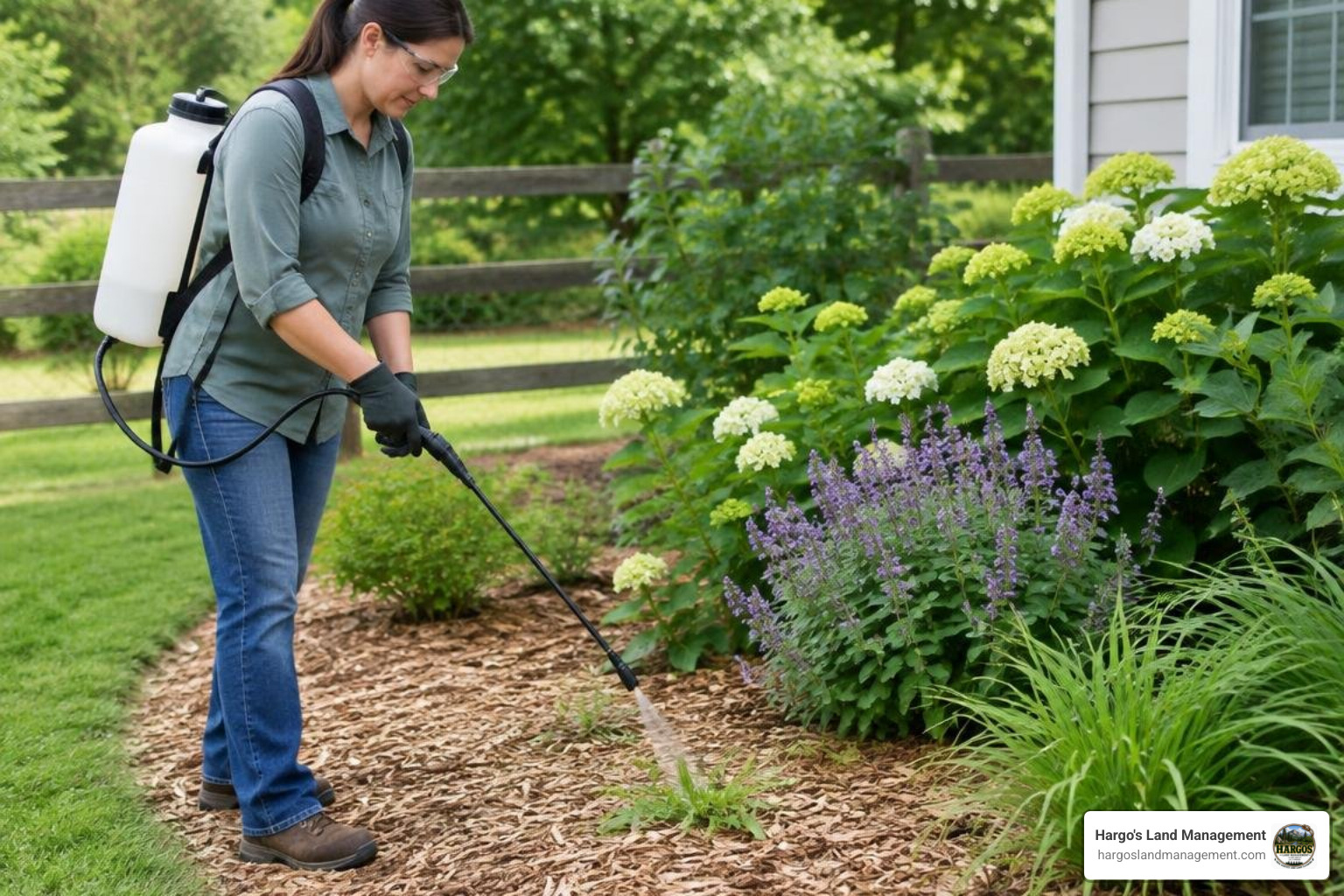
Property owners often weigh natural alternatives against synthetic chemicals. Understanding the mechanisms, benefits, and trade-offs of each category allows for informed decisions based on site-specific goals.
| Method Type | Primary Advantages | Limitations and Risks | Ideal Applications |
|---|---|---|---|
| Natural / Organic | Non-toxic to soil biology; zero synthetic residue; pet-safe once dried; improves soil organic matter when mulching | Non-selective; lacks systemic action (top-burn only); requires multiple applications on perennials; higher labor demand | Vegetable beds, residential hardscapes, organic farms, flower garden borders |
| Chemical Synthetic | Systemic translocation kills deep roots; selective options spare desirable lawn grasses; cost-effective for large acreages | Potential runoff risk; non-target drift injury; risk of herbicide resistance; potential health and environmental concerns | Large acreage pastures, severe noxious weed outbreaks, selective turf weed management |
Natural and Organic Weed Control for Homeowners
For homeowners seeking natural yard management, several non-synthetic solutions yield reliable results:
- Horticultural Vinegar (20% Acetic Acid): Unlike household table vinegar (5% concentration), 20% horticultural vinegar breaks down the waxy cuticle on weed leaves, causing rapid desiccation on sunny days. It is a non-selective contact burndown agent and does not translocate to perennial roots. Caution: Horticultural vinegar is corrosive to skin, eyes, metal fixtures, and stone pavers.
- Boiling Water: Dousing small weeds in sidewalk joints, paver driveways, and gravel paths with boiling water cooks plant tissue down to the upper root crown. It is completely non-toxic and cost-effective, though it should never be used near desirable garden root zones.
- Corn Gluten Meal: A byproduct of corn milling, this organic pre-emergent releases natural dipeptides that inhibit root development in newly germinating seeds. It provides 4 to 6 weeks of suppression while contributing organic nitrogen to the soil. Note: It also prevents desirable turf seeds from germinating, so avoid applying it when overseeding.
- Coarse Wood Chip Mulch: Maintaining a clean 3-to-4-inch layer of clean wood chips or bark blocks photosynthetically active radiation from reaching the soil floor. As explored in our review of lawn weed management strategies, combining deep mulch layers with spot-hand weeding creates a reliable chemical-free barrier.
Chemical Weed Control and Herbicide Selection
When chemical tools are required, selecting the correct chemical class and formulation prevents unintentional turf damage and off-target drift:
- Pre-Emergent Herbicides: These compounds create a microscopic chemical barrier across the soil surface that inhibits cell division in germinating weed seeds. They must be applied before soil temperatures reach the germination threshold of target weeds (typically 50°F to 55°F in early spring for crabgrass). They do not kill established plants.
- Post-Emergent Herbicides: These products treat weeds that are actively growing. They fall into two subcategories:
- Contact Herbicides: Destroy only the plant tissue they directly touch. Excellent for annuals, but perennials will resprout from underground roots.
- Systemic Herbicides: Absorbed through the leaves or root system and translocated throughout the entire vascular system, killing deep root nodes. Systemic herbicides are most effective on perennials in late summer and autumn when plants pull nutrients down toward their roots.
- Selective vs. Non-Selective:
- Selective Herbicides: Target specific plant families while leaving others unharmed (such as broadleaf weed killers that eliminate dandelions without injuring lawn grasses). Specific products are engineered for targeted problems, such as controlling spurge and invasive weeds across residential turf.
- Non-Selective Herbicides: Kill or injure nearly all green vegetation they contact (such as glyphosate or glufosinate). These are best reserved for gravel lots, fencelines, and spot-renovations.
Chemical applications carry legal and environmental responsibilities. Broad-spectrum active ingredients have prompted substantial litigation and environmental scrutiny; for instance, Bayer has settled over 100,000 legal claims regarding glyphosate (Roundup) for approximately $11 billion, with tens of thousands of claims still active. Always read pesticide labels in full, follow specified Personal Protective Equipment (PPE) standards, avoid applying in windy conditions (>5 mph) to prevent spray drift, and refrain from spraying before heavy rain to protect regional watersheds.
Integrated Weed Management and Resistance Prevention
Integrated Weed Management (IWM) does not rely on a single silver bullet. Instead, it combines biological, cultural, mechanical, and chemical tactics to maintain weed populations below damaging thresholds while preventing environmental degradation.
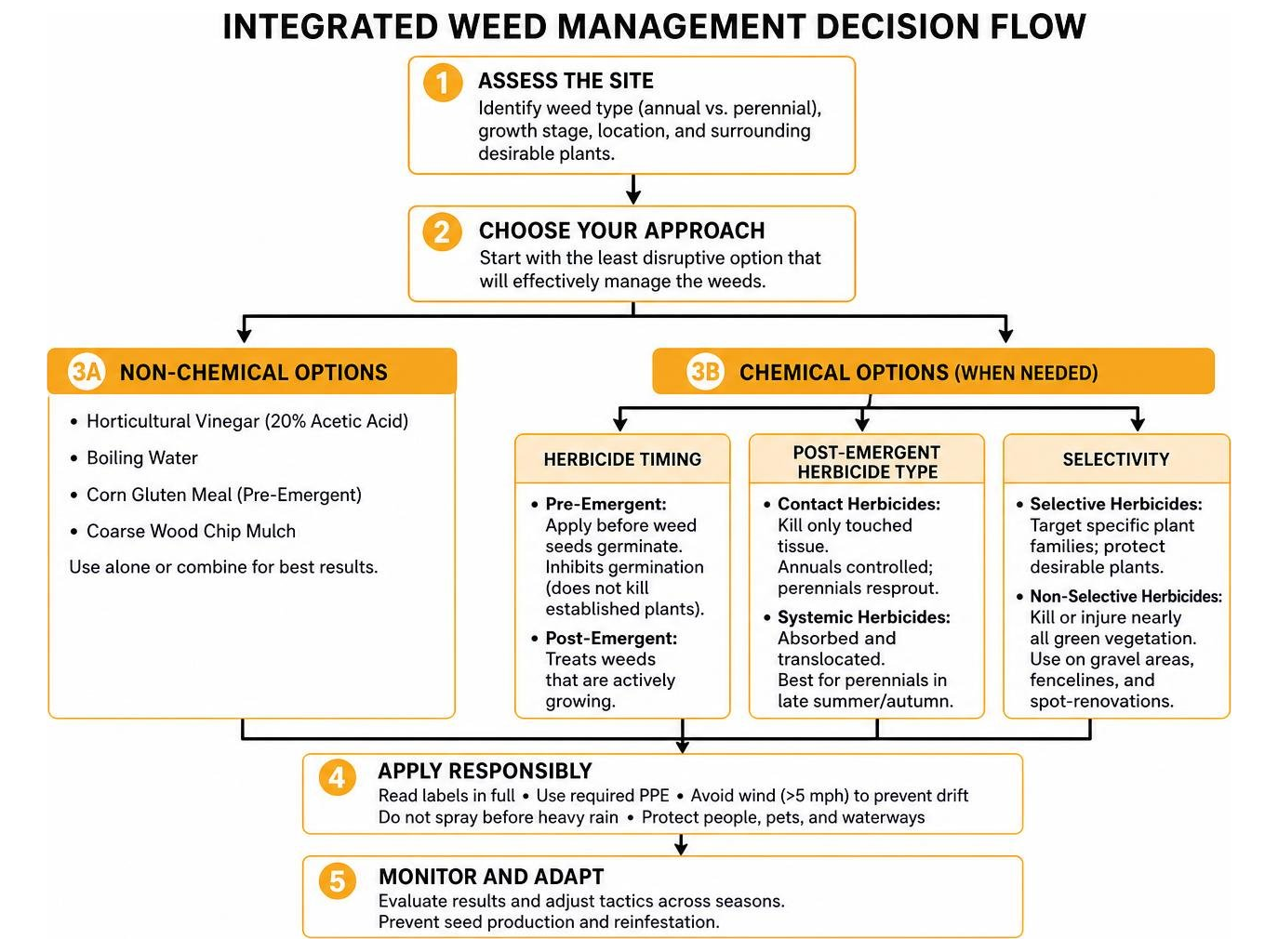
As highlighted in the Montana Extension handbook on integrated weed management, IWM views weed suppression through an ecological lens, adjusting tactics across seasons based on ongoing field monitoring.
Preventing Weed Spread and Seed Contamination
The most cost-effective weed management step is preventing initial introduction to your property:
- Certified Weed-Free Forage: Livestock owners, equestrian properties, and land managers should use feeds certified under regional Weed-Seed-Free Forage programs to prevent introducing aggressive species like houndstongue, knapweed, or leafy spurge via hay bales.
- Equipment Sanitation: Mowers, skid-steers, tractors, and excavators collect seeds, mud, and root fragments in their undercarriages and mower decks. Power-washing equipment before moving between project sites prevents the introduction of weed seed banks.
- Boot and Gear Decontamination: Burrs and hooked seeds (such as puncturevine and houndstongue nutlets) cling to boot laces, animal fur, and vehicle tires. Inspect gear before leaving infested pastures.
- Stale Seedbed Preparation: Before planting a pasture, lawn, or garden plot, irrigate the tilled ground to stimulate weed seed germination. Once seedlings emerge, kill them with a shallow flame weeder, solar tarp, or light contact spray, clearing the top seed layer before sowing desirable crops.
For extensive rural parcels, pairing prevention with comprehensive brush and land clearing resets overgrown spaces and eliminates mature seed caches before systematic maintenance begins.
Managing Herbicide Resistance
Repeatedly using the same herbicide chemistry selects for naturally resistant weed biotypes. When a chemical with an identical Mode of Action (MOA) is applied year after year, the few weeds with natural genetic resistance survive, cross-pollinate, and multiply. Within several generations, the entire population becomes immune to that herbicide family. A notable example occurred in Western Australia, where intensive reliance on single chemistries caused ryegrass to evolve resistance across four herbicide classes in under a decade.
To prevent and manage resistance:
- Rotate Chemical Modes of Action: Check the herbicide label for its Group Number (which categorizes the site of action) and alternate between different groups across seasons.
- Integrate Harvest Weed Seed Control (HWSC): Innovative mechanical tools, such as the Harrington Seed Destructor (which mills and destroys up to 95% of weed seeds in chaff during crop harvesting) or post-harvest windrow burning (practiced by roughly 70% of Western Australian grain growers), eliminate resistant seeds before they reach the dirt.
- Use Tank Mixes with Multiple MOAs: Combining two distinct herbicide classes with different biological mechanisms reduces the odds of any individual plant surviving.
- Spot Spray Rather Than Broadcast: Treat individual weed escapes by hand rather than blanket-spraying entire properties with non-selective chemistries.
Legal Regulations, Noxious Weeds, and Fire Safety
Weed control is more than an aesthetic preference—it is often a legal responsibility and a fire-safety priority. State and local governments classify destructive non-native plants as Noxious Weeds. Unlike common lawn weeds, noxious weeds are legally regulated because they threaten agricultural economies, disrupt native ecosystems, poison livestock, or increase community disaster risk.
Under statutes like the Montana County Noxious Weed Control Act and similar county laws across Western states, landowners are legally responsible for managing designated noxious weeds on their properties. Failure to comply can result in county weed districts entering private land to perform abatement work at the owner’s expense, alongside administrative citations.
In regions prone to wildfire, like the western foothills of California and El Dorado County, invasive weeds pose an immediate hazard by acting as “fine fuels.” Annual weeds such as cheatgrass, yellow starthistle, mustard, and medusahead grow rapidly during wet spring months, producing heavy biomass. As summer sets in, these plants dry out completely, transforming into volatile tinder that ignites easily from discarded matches, vehicle exhaust, or lightning strikes.
Weeds also serve as “ladder fuels,” carrying ground fires into native brush and up into tree canopies. Implementing proactive weed suppression along fencelines, driveways, and property boundaries is essential for reducing wildfire dangers through proactive clearing. Property owners should maintain at least 100 feet of clean defensible space around all structures, combining perimeter mowing with defensible space landscaping services to protect homes and neighborhoods.
Frequently Asked Questions About Weed Management
What is the most effective time of year to treat weeds?
The best treatment window depends on the weed’s lifecycle:
- Early Spring: Apply pre-emergent products for summer annuals (like crabgrass) when soil temperatures reach 50°F to 55°F for several consecutive days, before shoots emerge.
- Late Spring / Early Summer: Mow, pull, or mechanically cultivate annual and biennial broadleaf weeds while they are young and actively growing, well before they produce flowers or set seed.
- Late Summer / Autumn: Treat perennial broadleaf weeds (such as thistles, dandelion, bindweed) with systemic post-emergents. As perennials prepare for winter, their vascular system translocates foliar-applied compounds directly into deep roots and rhizomes, delivering better long-term control than spring applications.
How does dense weed overgrowth increase wildfire risk?
Dense weed growth functions as fine fuel with high surface-area-to-volume ratios. When annual grasses and invasive broadleaf weeds dry out in summer, their moisture content drops near zero, making them easy to ignite. These low-growing weeds act as fire bridges across pastures and driveways, carrying fires from roadsides directly toward homes while igniting taller brush and tree canopies.
Can invasive weeds be eradicated permanently from a property?
Total permanent eradication of all weeds on an outdoor parcel is rarely realistic due to extensive subterranean seed banks, airborne seed dispersal from surrounding properties, and wildlife movement. However, weeds can be suppressed below damaging economic and aesthetic thresholds through consistent Integrated Weed Management. By eliminating visible seed production each year, preserving competitive ground covers, and regularly monitoring property borders, the weed seed bank will decline over time, requiring significantly less labor to maintain each season.
Conclusion
Effective weed management is an ongoing journey of land stewardship rather than a one-time project. By understanding weed life cycles, pairing mechanical removal with cultural prevention, sanitizing equipment, and using natural or targeted chemical options responsibly, you can protect property values, preserve soil vitality, and safeguard native ecosystems.
Managing large-scale weed infestations, heavy brush, and rural acreage often requires heavy machinery, proper licensing, and specialized safety planning. When invasive weeds, dense scrub, or fire-season fuel loads threaten your land, our experienced crew at Hargo’s Land Management is here to help. As a locally owned, licensed, bonded, and insured team serving El Dorado County—including Placerville, South Lake Tahoe, and neighboring communities—we deliver fast, fire-safety-focused clearing and tree care. Contact us today for a free on-site estimate and secure your property with our professional weed abatement services.
CUSTOMER REVIEWS & TESTIMONIALS
We strive to exceed your expectations. See what our customers have to say.



















CONTACT US TODAY
Serving El Dorado and Surrounding Counties
Locally owned and operated since 2013. Use our live chat support to get in touch about your land management needs today.
Request a free evaluation and estimate by completing our online form or book an on-site appointment.
El Dorado County: El Dorado Hills, Cameron Park, Shingle Springs, Coloma, Placerville, Camino, Pollock Pines, South Lake Tahoe and more...
Amador County: Jackson, Ione, and Surrounding Towns
Sacramento County: Sacramento and Surrounding Cities
Placer County: Roseville, Rocklin, Auburn, and Everything In Between
Nevada County: Penn Valley, Nevada City, Grass Valley