
Stop Mudslides and Runoff Before Post-Fire Storms Hit
Erosion Control After Fire Starts Before the First Storm
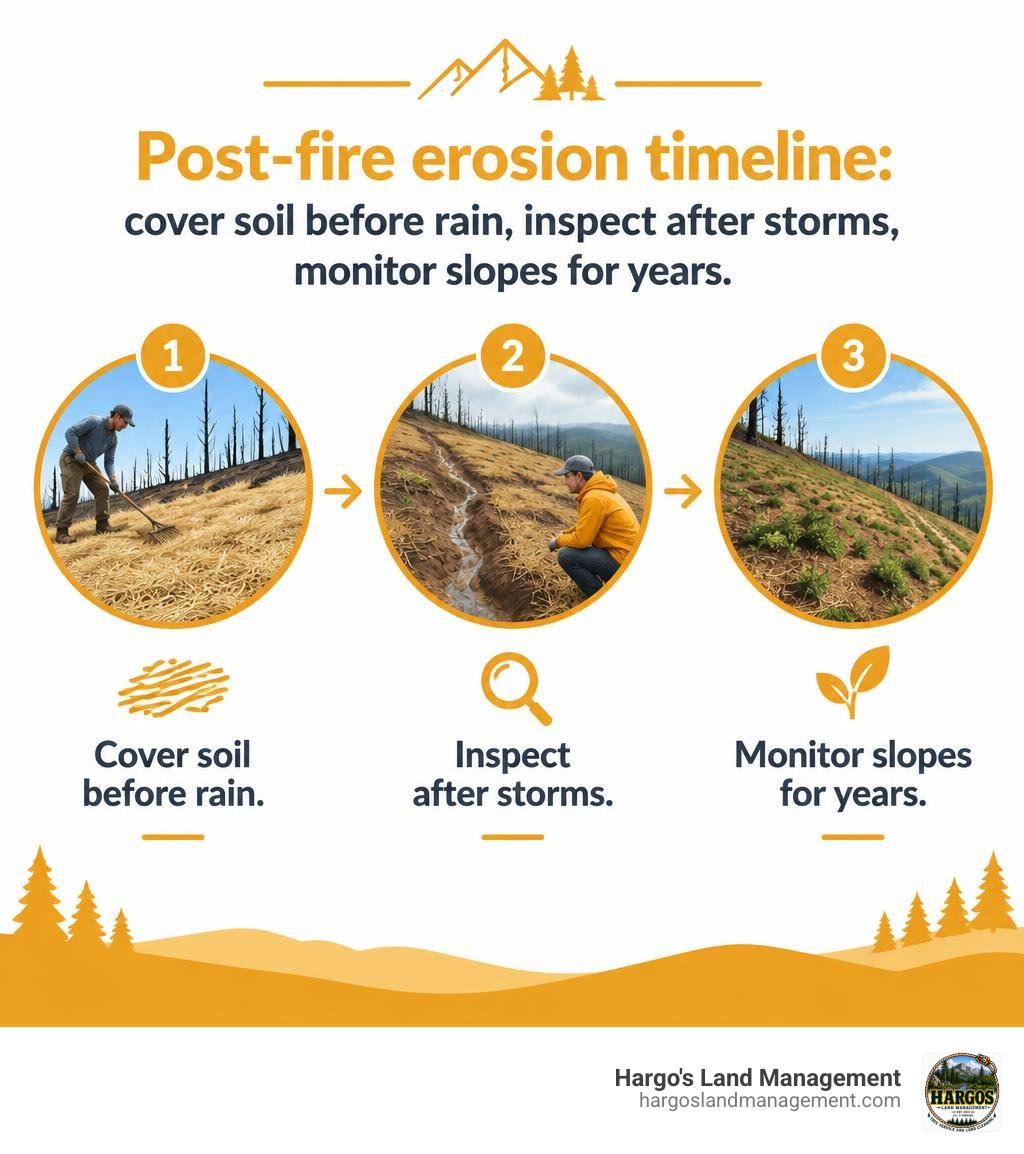
Cover bare soil before the first major rain. Weed-free straw or wood mulch can protect a burned slope right away; aim for roughly 60-70% ground cover. Check where runoff could collect near your home, driveway, or drainage channels, and have a qualified professional assess steep or badly burned areas. Seeding alone takes too long to protect soil during the first storms.
The risk does not end when the flames are out. Rain can wash exposed soil downhill, while burned roots may weaken over the next two to three years. Start with the slopes that threaten people or property, then inspect them after each storm and repair any new rills or gaps in the mulch.
Key terms for erosion control after fire:
The Hidden Hazard: Why Burned Landscapes Face Severe Runoff and Debris Flows
When a wildfire tears through a hillside, it consumes more than just the standing timber and brush. It vaporizes the protective forest litter layer—leaves, needles, twigs, and organic humus—that acts as nature’s sponge. Without this sponge, hillslope hydrology fundamentally shifts. Erosion in the first year following a wildfire can skyrocket by up to three orders of magnitude compared to undisturbed ground.
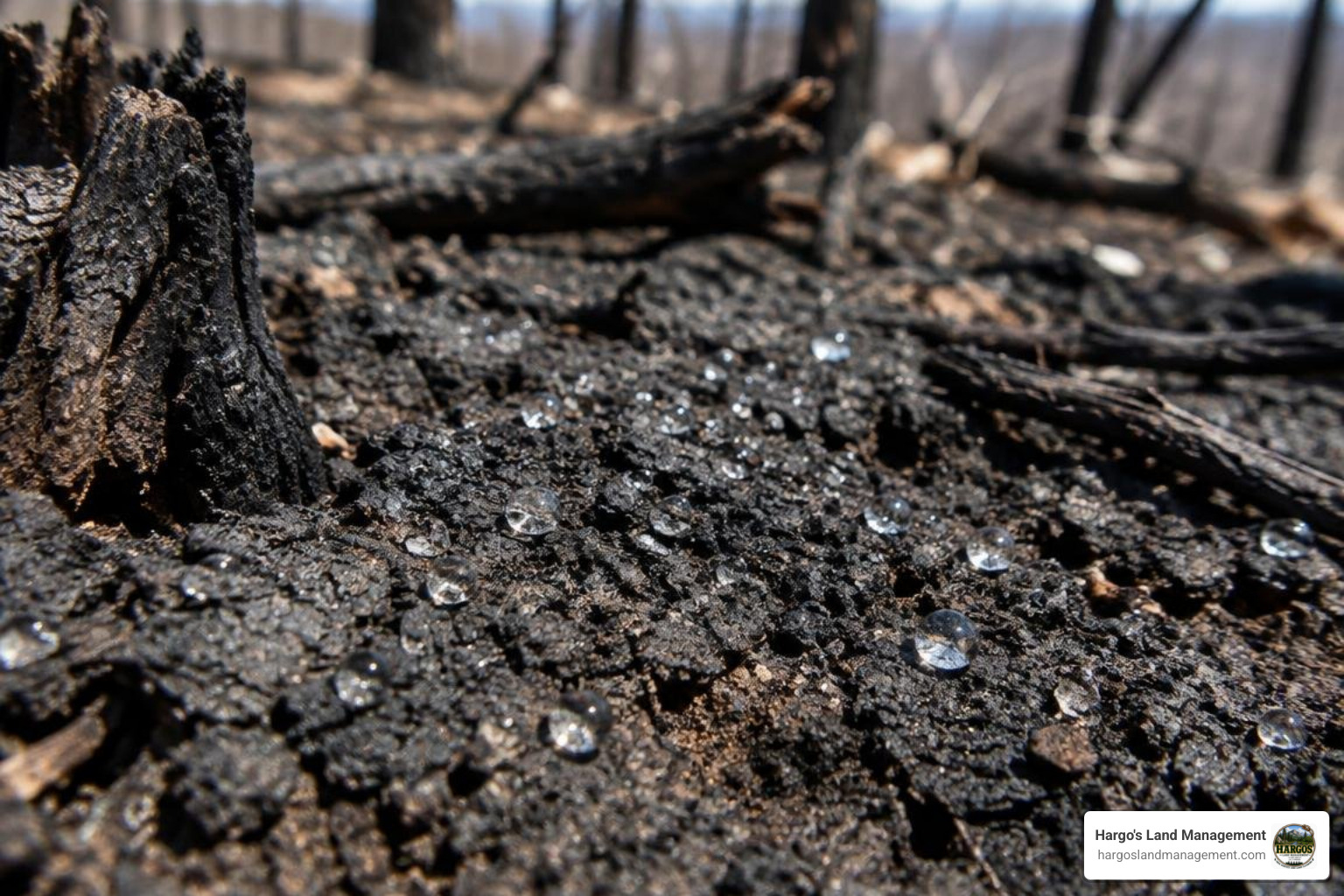
A healthy, unburned hillside typically absorbs 80% to 90% of a storm’s rainfall, releasing it slowly into subterranean aquifers and stream channels. Immediately following a moderate or high-severity burn, that same slope may absorb less than 20% of the rainfall. As detailed in federal research on post-fire treatment effectiveness for hillslope stabilization, exposed mineral soil leaves the landscape vulnerable to flash flooding, severe rilling, and destructive mudslides.
How Wildfire Heat Creates Hydrophobic Soil
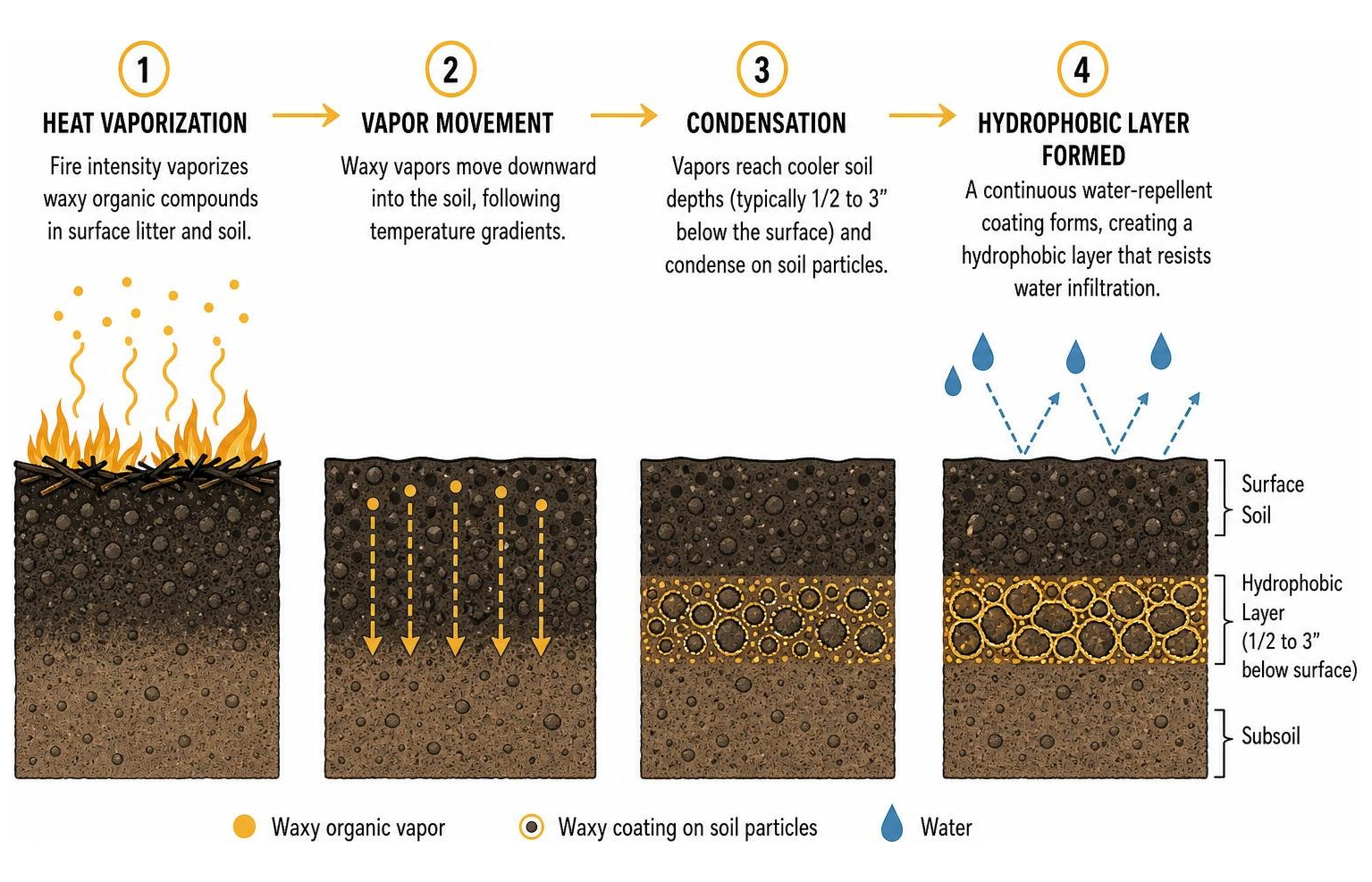
The most dangerous subsurface change following a burn is the formation of a hydrophobic (water-repellent) soil layer. As intense heat burns organic matter on the surface, it vaporizes waxy organic compounds. These gaseous hydrocarbons penetrate the porous topsoil, moving downward along temperature gradients away from the heat.
Once these vapors hit cooler soil depths—typically between a half-inch and three inches below the surface—they condense around individual soil particles. This forms a continuous, water-resistant coating. The soil is essentially sealed off against infiltration.
The persistence and depth of this water-repellent layer depend heavily on burn severity:
- Low-Severity Burns: Produce shallow, patchy hydrophobic layers that often break down within a few weeks as moisture and biological activity return.
- Moderate to High-Severity Burns: Generate deep, uniform, highly impervious layers that can persist for a year or more, completely shedding rainfall like fresh asphalt.
Rainfall Intensity, Root Decay, and Slope Failure Mechanics
Post-fire erosion is not simply a function of total seasonal rainfall; it is dictated primarily by short-duration, high-intensity rainfall bursts. When high-intensity rain falls on hydrophobic ground, raindrops cannot soak in. Instead, rainsplash detachment dislodges unprotected mineral soil particles, kicking off sheetwash and rapid rill formation. Rills and channels rapidly expand, accounting for 60% to 80% of total hillslope sediment loss.
Compounding this immediate surface vulnerability is root decay. Live tree and brush root networks provide critical mechanical cohesion to steep slopes. When a fire kills this vegetation, the roots do not vanish overnight; instead, they undergo a progressive decomposition process. Slope cohesion steadily deteriorates over two to three years post-fire, creating a secondary peak in landslide susceptibility just as property owners assume the danger has passed.
The catastrophic danger of this dynamic was demonstrated during the 2018 Montecito disaster in Southern California. Just six weeks after the Thomas Fire stripped the hillsides, an intense cell dropped less than half an inch of rain in five minutes. That short burst mobilized loose ash and hydrophobic topsoil into massive debris flows, resulting in 23 fatalities and destroying hundreds of homes. Understanding these mechanics is why our team at Hargo’s Land Management treats post-fire hillslope stabilization with absolute urgency across El Dorado County and the Sierra Nevada foothills.
Emergency Assessment: How BAER Frameworks Prioritize Post-Fire Action
Federal agencies like the USDA Forest Service rely on Burned Area Emergency Response (BAER) frameworks to address critical post-wildfire hazards. BAER teams do not attempt to rehabilitate an entire burn perimeter; instead, they focus emergency stabilization on steep, high-risk catchments directly upstream of “values-at-risk”—human lives, homes, access roads, and municipal water intakes.
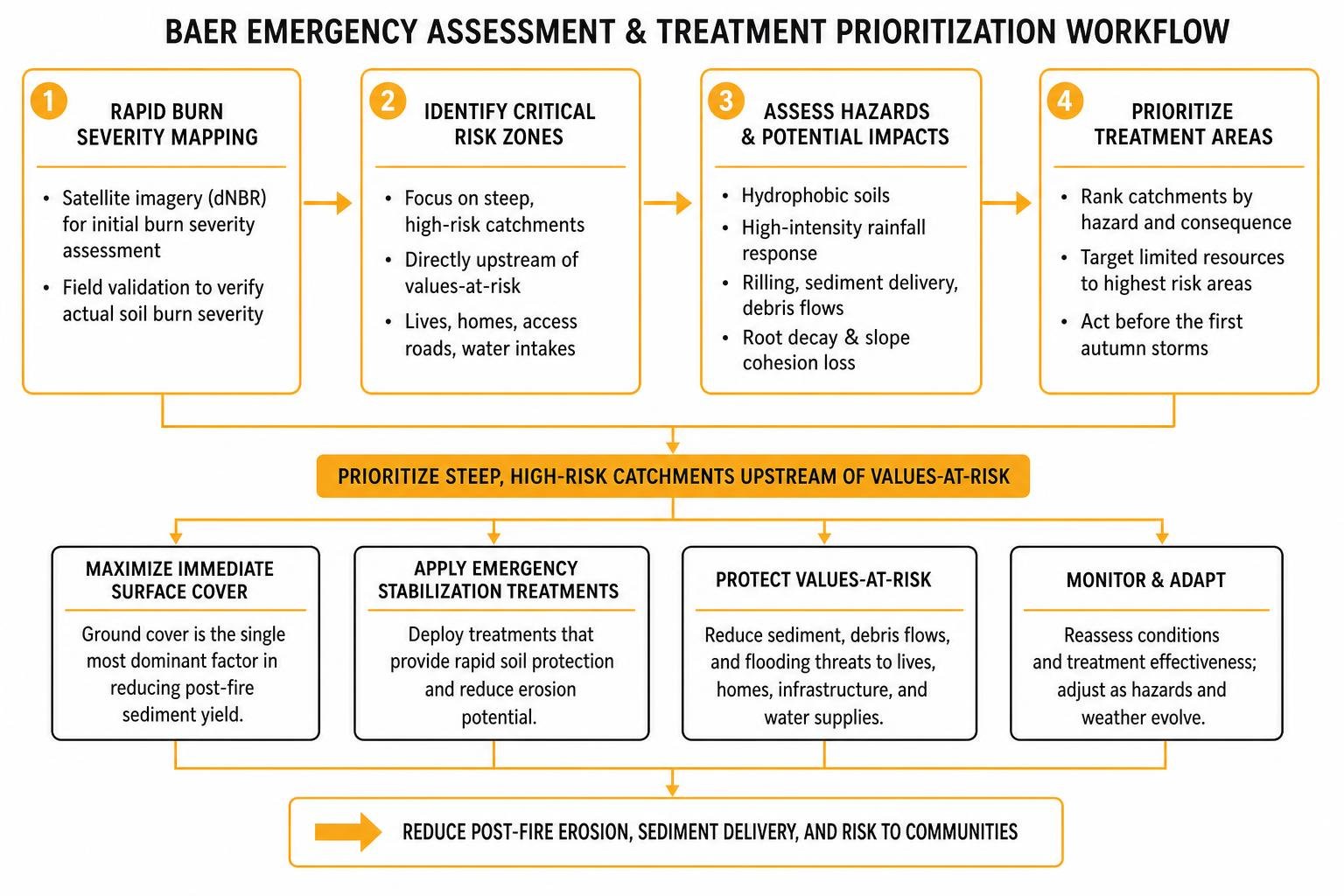
Published scientific data on post-fire erosion and emergency rehabilitation treatments demonstrates that ground cover is the single most dominant factor determining post-fire sediment yield. BAER protocols use this finding to triage landscapes and deploy treatments that maximize immediate surface cover before the first autumn storms arrive.
Mapping Soil Burn Severity and Critical Risk Zones
Effective stabilization begins with rapid risk mapping. Satellite imagery (such as differenced Normalized Burn Ratio, or dNBR) provides an initial landscape-scale view of vegetative burn severity. However, field validation is essential to verify actual soil burn severity:
- Ash Depth and Color: White or light-gray ash signifies high-severity combustion where all organic matter was consumed; dark gray or black ash indicates lower severity.
- Soil Structure and Hydrophobicity: Field specialists test water drop penetration time (WDPT) to evaluate the depth and strength of water repellency.
- Slope Angle and Catchment Confinement: Slopes exceeding 25% to 60% with convergent drainage paths present the highest risk for rill development and downstream debris flows.
The Critical Pre-Storm Response Window
The timeline between wildfire containment and the first major rainfall event represents the only window to prevent large-scale soil movement. Once rains begin and hydrophobic soils start shedding water, mobilizing heavy machinery or hand crews becomes hazardous and can cause further structural damage to fragile slopes. Rapid mobilization is vital.
Private property owners must assess their individual risk profiles immediately. If you have bare hillsides above your driveway or living areas, clearing drainage culverts, applying surface protection, and integrating defensible space clearing strategies should occur before the storm clouds gather.
Proven Methods for Erosion Control After Fire: Comparing Hillslope Treatments
Selecting the right emergency treatment requires matching the method to slope grade, accessibility, burn severity, and cost.
| Treatment Method | Best Slope Grade | Target Cover % | First-Year Sediment Reduction | Durability / Longevity | Relative Cost |
|---|---|---|---|---|---|
| Agricultural Straw Mulch | < 60% | 60% – 70% | 60% – 90% | 1 – 2 Seasons | Moderate |
| Wood Strand Mulch | Any Grade | 60% – 80% | 75% – 95% | 3 – 5 Seasons | High |
| Straw Wattles / Fiber Rolls | < 40% | N/A (Linear) | 20% – 40% | 1 – 2 Seasons | Low to Moderate |
| Contour-Felled Logs (LEBs) | 25% – 60% | N/A (Linear) | 20% – 50% (Low storms only) | 2 – 4 Seasons | High (Labor) |
| Hydromulch with Tackifier | Steep / Inaccessible | 70% – 100% | 19% – 70% | 0.5 – 1 Season | High |
| Aerial Grass Seeding Alone | Any Grade | Variable (<25%) | Negligible (<5%) | Delays 1 Year | Low |
For landowners looking to protect access roads and structures, reviewing official guidance on post-fire hillslope mitigation ensures interventions match site-specific terrain constraints.
Dry Mulching vs. Seeding for Erosion Control After Fire
For decades, the standard response to wildfire was broadcast grass seeding. However, long-term post-fire studies have shown that grass seeding treatments provide little to no measurable erosion reduction during the critical first year. In the first growing season after a burn, only about 22% of seeded sites achieve the 60% ground cover threshold required to reduce sediment transport. Seeds simply cannot germinate and establish root networks quickly enough to withstand early autumn downpours.
By contrast, dry mulching provides instant ground cover. It absorbs the kinetic energy of falling raindrops, prevents soil crusting, and physically slows surface runoff velocity.
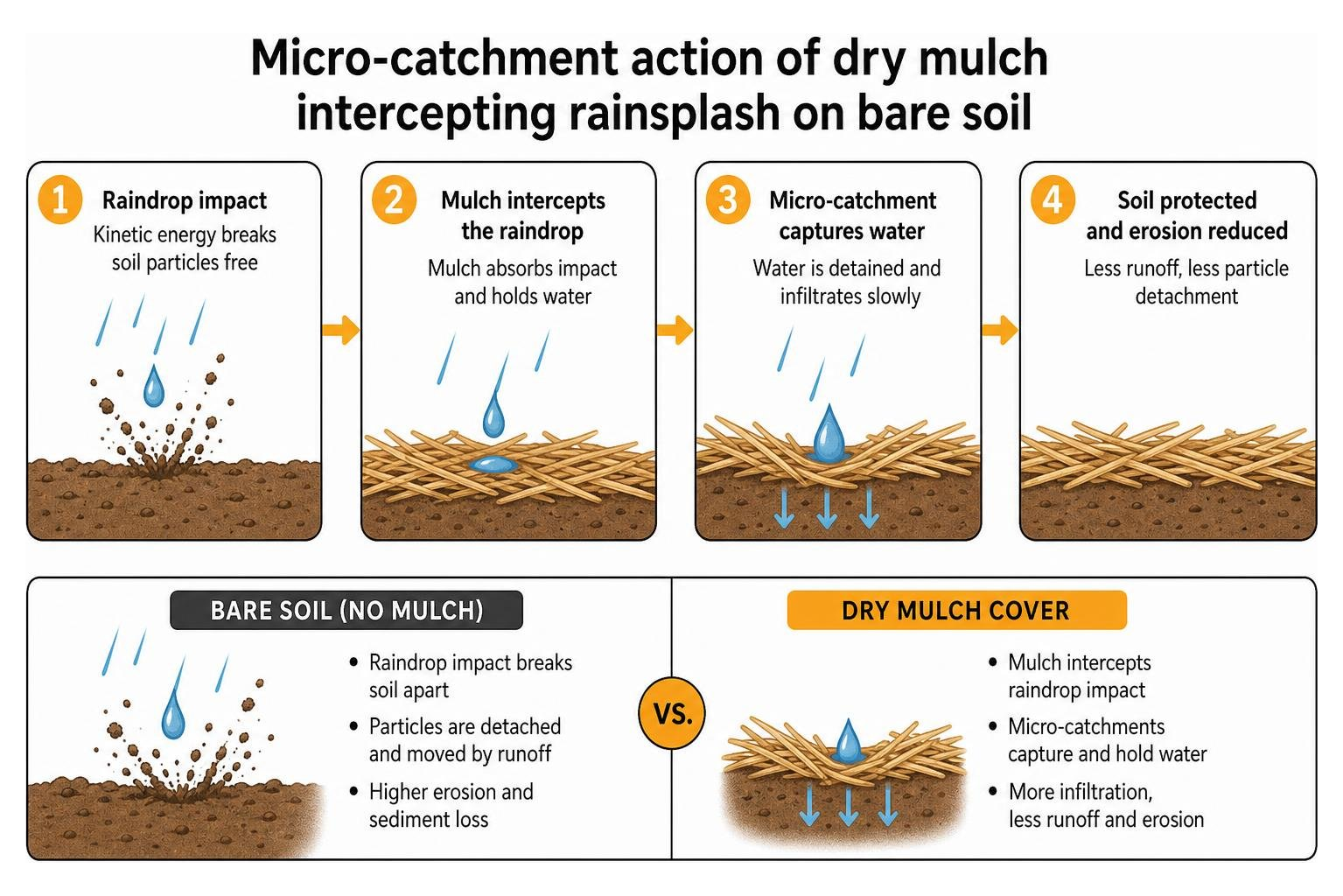
According to landmark research on post-fire erosion mitigation treatments, data from the 2002 Hayman Fire demonstrated that untreated catchments produced 22.2 tonnes per hectare of sediment in year one, whereas catchments treated with wheat straw mulch produced only 8.9 tonnes per hectare—a 63% reduction. In year two, straw-treated catchments still produced 68% less sediment than untreated controls.
When choosing dry mulch:
- Certified Weed-Free Straw: Economical and highly effective, though vulnerable to wind displacement on exposed ridge lines.
- Wood Strands / Wood Shreds: Engineered wood mulch fragments (ideally over 2 inches long) resist wind blowing, provide superior interlocking ground cover, and persist through multiple seasons without introducing invasive seeds.
- Needle Cast: Natural pine needle mulch falling from fire-killed tree canopies can reduce interrill erosion by 60% to 80% if it reaches 50% ground cover.
Mechanical Barriers: Straw Wattles, Logs, and Silt Fences
Mechanical barrier treatments are designed to slow runoff velocity, split overland flows, and trap sediment on the slope face. However, their real-world performance is mixed compared to dry mulches.
Contour-felled log erosion barriers (LEBs) utilize standing dead timber felled directly across the slope contour. While they offer a 20% to 50% sediment reduction in low-to-moderate rain events, their capacity fills quickly during heavy storms. More critically, if logs are installed even slightly off-contour, they act as funnels—concentrating sheet flow and carving deep, destructive rills underneath the log.
Straw wattles and fiber rolls serve well on moderate slopes (under 40%) along road cuts and building pads, provided they are properly trenched (3 to 5 inches deep) and securely staked. Pairing these installations with targeted brush and land clearing allows crews to clear burned debris while establishing functional drainage benches.
Applying Hydroseeding for Erosion Control After Fire on Steep Terrain
On rocky, steep, or inaccessible slopes where ground crews cannot safely spread dry mulch, hydraulic applications become a vital tool.

Modern hydroseeding erosion control utilizes bonded fiber matrices (BFM), organic tackifiers, wood fibers, and specialized native seed blends. The tackifier glues the fiber blanket directly to hydrophobic soils, offering immediate raindrop interception while holding seed in place until moisture allows for germination.
Long-term empirical research evaluating hillslope treatments using the evaluation of post-fire treatments and ERMiT modeling shows that standard hydromulch without robust tackifiers can break down rapidly under severe weather. Ensuring the mix incorporates high-performance polymer tackifiers and heavy wood fiber loading is essential to achieve durability across the winter storm cycle.
Multi-Year Recovery: Protecting Slopes While Vegetation Re-Establishes
Hillslope stabilization is not a one-time event; it is a multi-year recovery process. While post-fire erosion rates typically decline by roughly an order of magnitude with each passing year, catastrophic storms in years four through seven can still trigger deep slope failures if vegetative recovery is incomplete.
Establishing a long-term strategy that combines professional erosion control services with ongoing vegetation management ensures that hillsides transition smoothly from emergency surface protection to deep-rooted, living stabilization.
Managing Invasive Species and Promoting Native Regrowth
Wildfires create a clean slate, but invasive annual weeds (such as cheatgrass, yellow starthistle, and medusahead) are often the first to capitalize on the open ground and flush of soil nutrients. Invasive annual grasses have shallow, fibrous root systems that do very little to anchor deeper soil horizons. Worse, they dry out early in the summer, creating fine fuel beds that dramatically shorten future fire return intervals.
Supporting native woody shrubs, perennial bunchgrasses, and deep-rooted trees is critical. Using certified weed-free mulch materials ensures you don’t inadvertently import problematic seeds to your property. Where native seed banks remain intact beneath moderate burns, light mulching (maintaining 60% to 70% cover) preserves soil moisture without burying emerging native shoots under an impenetrable barrier.
Long-Term Slope Monitoring and Maintenance Protocols
After your emergency stabilization measures are deployed, adopt an active inspection routine throughout the wet season:
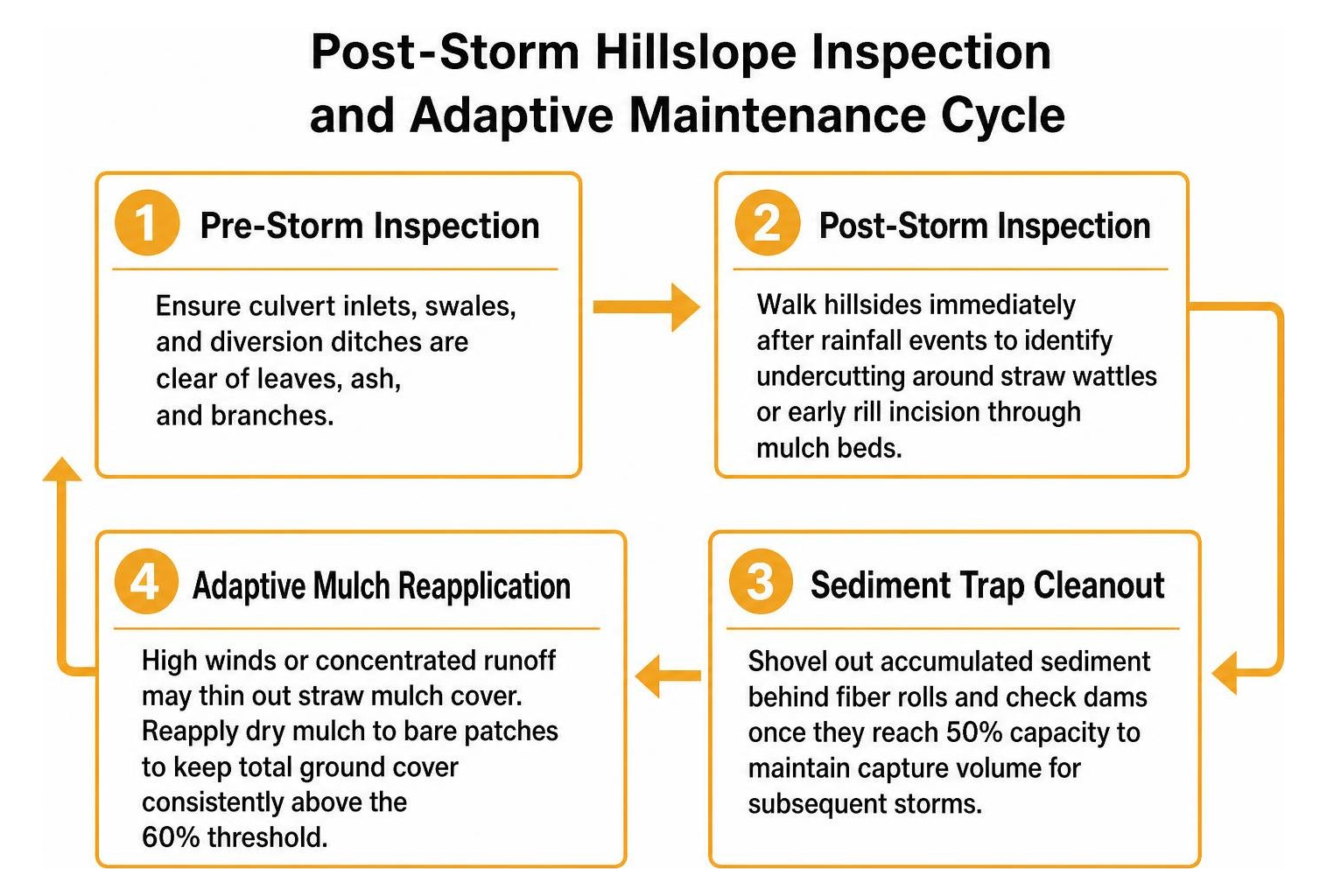
- Pre-Storm Inspection: Ensure culvert inlets, swales, and diversion ditches are clear of leaves, ash, and branches.
- Post-Storm Inspection: Walk hillsides immediately after rainfall events to identify undercutting around straw wattles or early rill incision through mulch beds.
- Sediment Trap Cleanout: Shovel out accumulated sediment behind fiber rolls and check dams once they reach 50% capacity to maintain capture volume for subsequent storms.
- Adaptive Mulch Reapplication: High winds or concentrated runoff may thin out straw mulch cover. Reapply dry mulch to bare patches to keep total ground cover consistently above the 60% threshold.
Frequently Asked Questions About Post-Fire Hillslope Protection
How soon after a wildfire should erosion control measures be installed?
Erosion control treatments should ideally be installed within days to weeks of fire containment, and strictly before the first major soaking rainstorm of the autumn season. The initial storms of the season frequently generate the highest sediment yields because soils are completely bare, ash is unconsolidated, and water repellency is at its peak.
Why is seeding alone ineffective for first-year post-fire erosion?
Seeding alone fails to protect soil during the critical first year because seeds require weeks of favorable moisture and soil temperatures to germinate and develop canopy cover. Until plants reach at least 60% ground cover, the bare soil remains entirely exposed to rainsplash detachment and rill erosion. Mulching provides instantaneous, mechanical surface cover that protects the soil from day one.
How long does hydrophobic soil last after a severe wildfire?
In low-severity burns, soil water repellency typically breaks down within a few weeks to several months as soil microbes become active and light rain moistens the surface. In high-severity burns, deep hydrophobic layers can persist for a full year or more, requiring multiple freeze-thaw cycles, winter saturation, and mechanical root penetration to fully dissipate.
Conclusion
The destruction of a wildfire does not end when the smoke clears. Unprotected, hydrophobic hillslopes present severe risks of catastrophic erosion, sheetwash, and destructive debris flows throughout the wet season. Protecting your home, infrastructure, and landscape requires immediate, evidence-based intervention: establishing 60% to 70% ground cover with dry mulch, properly installing mechanical barriers, and maintaining culverts before storms arrive.
At Hargo’s Land Management, we live and work in the fire-prone communities of El Dorado County, South Lake Tahoe, and Placerville. We provide comprehensive land stewardship—from post-fire site assessments and rapid hillslope stabilization to multi-year defensible space clearing and hazard tree removal. We are fully licensed, bonded, and insured, offering free on-site estimates to help you stabilize your land safely and effectively.
Don’t wait for heavy rains to test your burned ground. Contact our team today to develop a customized post-fire erosion management plan before the next storm hits.
CUSTOMER REVIEWS & TESTIMONIALS
We strive to exceed your expectations. See what our customers have to say.



















CONTACT US TODAY
Serving El Dorado and Surrounding Counties
Locally owned and operated since 2013. Use our live chat support to get in touch about your land management needs today.
Request a free evaluation and estimate by completing our online form or book an on-site appointment.
El Dorado County: El Dorado Hills, Cameron Park, Shingle Springs, Coloma, Placerville, Camino, Pollock Pines, South Lake Tahoe and more...
Amador County: Jackson, Ione, and Surrounding Towns
Sacramento County: Sacramento and Surrounding Cities
Placer County: Roseville, Rocklin, Auburn, and Everything In Between
Nevada County: Penn Valley, Nevada City, Grass Valley