
Safeguard Your Lawn with the Best Spurge Weed Killer Options on the Market
Identifying Spurge and Look-Alikes Before Selecting Herbicides
For actively growing infestations, the best spurge weed killer is a specialized selective post-emergent containing MCPA, triclopyr, and dicamba, such as Spurge Power, while prodiamine is the most effective pre-emergent for preventing spurge seeds from sprouting. Before reaching for an herbicide, accurate weed identification is still crucial. Spotted spurge (Euphorbia maculata) and prostrate spurge (Euphorbia prostrata) are fast-growing summer annual broadleaf weeds. They germinate rapidly once soil temperatures reach 60°F to 65°F and form dense, low-growing mats that choke out turfgrass in compacted or thin soil.
A single spotted spurge plant can produce up to 2,500 seeds in a single season, while a prostrate spurge plant yields up to 2,000 seeds. Compounding the problem, dry spurge seed capsules can forcefully eject seeds up to 15 feet away.
To identify spurge correctly on your property, look for these specific botanical traits:
- Growth Habit: Stems radiate outward from a central taproot, forming flat, circular mats up to two feet in diameter.
- The Milky Latex Test: Snap any stem; spurge immediately exudes a thick, milky white sap (latex). This sap is a skin and eye irritant.
- Leaf Characteristics: Small, opposite, oval leaves that are dark green. Spotted spurge displays a characteristic dark red or purple blotch in the center of each leaf.
- Waxy Cuticle: Mature spurge foliage develops a waxy coating that repels water and makes foliar herbicide absorption difficult without an adjuvant.
- Root System: A deep, slender taproot anchors the plant firmly into dry, packed dirt.
Key Visual Differences: Spurge vs Purslane and Knotweed
Spurge is frequently confused with common purslane (Portulaca oleracea) and prostrate knotweed (Polygonum aviculare). Applying broadleaf herbicides without distinguishing these weeds can lead to wasted product and poor control.
| Identification Trait | Spotted / Prostrate Spurge | Common Purslane | Prostrate Knotweed |
|---|---|---|---|
| Stem Sap | Milky white latex | Clear, watery fluid | Clear, watery fluid |
| Leaf Structure | Thin, flat, opposite leaves | Thick, fleshy, succulent leaves | Alternate, narrow, oblong leaves |
| Leaf Markings | Often has a central red/purple spot | Uniform green, sometimes reddish edge | Dull blue-green, no central spot |
| Stem Junctions | Smooth stem nodes | Fleshy, smooth joints | Enclosed by a papery sheath (ochrea) |
| Growth Form | Dense, prostrate radial mat | Sprawling, rubbery succulent mat | Wiry, tough, mat-forming stems |
Purslane leaves are thick and rubbery, and knotweed stems have distinct papery sheaths (ochrea) at each joint. Neither weed bleeds milky white latex when broken.
Evaluating the Best Spurge Weed Killer Formulations for Lawn Care
Choosing an effective herbicide requires understanding the differences between post-emergent options that eliminate actively growing weeds and pre-emergent products that stop seeds from sprouting. University trials and field data demonstrate that standard selective broadleaf products deliver high control rates when applied early in the season, whereas iron-based alternatives struggle against mature infestations.
| Herbicide Formulation | Primary Active Ingredients | Action Type | Early Summer Control | Late Summer Control | Primary Use Case |
|---|---|---|---|---|---|
| Specialized Spurge Blends (e.g., Spurge Power) | MCPA, Triclopyr, Dicamba | Selective Post-Emergent | 90–95% | 78–82% | Targeted spot treatment in cool-season turf |
| Standard 3-Way Broadleaf Mix (e.g., Trimec Classic) | 2,4-D, MCPP, Dicamba | Selective Post-Emergent | 87% | 61% | Broadleaf weed control across mixed lawns |
| Consumer Concentrates (e.g., Weed B Gon Max) | 2,4-D, Quinclorac, Dicamba | Selective Post-Emergent | 85% | 60% | General broadleaf and crabgrass spot sprays |
| Killex Concentrate | 2,4-D, Mecoprop, Dicamba | Selective Post-Emergent | 88% | 62% | Broad-spectrum selective broadleaf spray |
| Fiesta (Iron HEDTA) | Iron HEDTA | Selective Post-Emergent | 48% | 30% | Organic-compatible spot treatment |
| Prodiamine (e.g., Barricade) | Prodiamine | Pre-Emergent | 90%+ (Seed prevention) | N/A | Early spring residual seed barrier |
| Pendimethalin | Pendimethalin | Pre-Emergent | 88%+ (Seed prevention) | N/A | Spring application before 60°F soil temps |
For comprehensive lawn protection, combining targeted herbicide applications with effective weed control for lawns ensures consistent, long-term turf health.
Top Post-Emergent Products: Choosing the Best Spurge Weed Killer for Active Infestations
When active infestations take over turf, selecting the best spurge weed killer depends on targeting the weed’s waxy leaves and resilient taproot. Standard retail mixes often lose efficacy as the summer progresses—control drops from roughly 85–88% on young weeds down to 60–62% on mature late-summer mats.
Specialized post-emergent herbicides such as Monterey Spurge Power overcome this resistance. Combining MCPA, Triclopyr, and Dicamba, these systemic formulas enter through foliar tissue and translocate down into the taproot to prevent regrowth. While triclopyr provides exceptional broadleaf knockdown, checking local and regional restrictions is always recommended before treating large areas. Detailed application methods and product options are outlined in How to Kill Spurge on Long Island (Exact Mix Rate, Best Products) and reviews of the 5 Best Herbicide for Spurge In 2026.

For warm-season lawns like Bermuda or Zoysia, alternatives like Celsius WG (iodosulfuron, thiencarbazone, and dicamba) or Southern Ag Amine 2,4-D offer dependable selective control without damaging turf in higher summer temperatures. Further details on specific active ingredient profiles are available in guides on Using Spurge Power Herbicide for Spotted and Prostrate Spurge Control.
Selecting the Best Spurge Weed Killer for Pre-Emergent Prevention
Stopping spurge before it emerges is far easier than treating mature mats. Pre-emergent herbicides create a chemical barrier in the top half-inch of soil that disrupts cell division when dormant seeds attempt to sprout.
- Prodiamine 65 WDG: Delivers over 90% control of spurge seedlings. Apply in early spring before soil temperatures reach 60°F at a two-inch depth.
- Pendimethalin: Provides 88%+ control of spurge and establishes a dependable residual barrier against summer annuals.
- Dithiopyr: Offers both pre-emergent prevention and very early post-emergent control on tiny, newly sprouted seedlings.
To maintain an unbroken barrier, apply pre-emergents in early spring and water the lawn with 0.5 inches of irrigation within 48 hours of treatment. For detailed seasonal schedules, consult resources like How To Get Rid Of Spurge In Your Lawn (2026) and practical overviews on using Spurge Killer In Grass.
Application Protocols: Mixing Rates, Surfactants, and Timing
Applying selective post-emergent herbicides requires accurate calibration and spraying techniques. Because spurge leaves have a waxy cuticle, spray droplets can bead up and roll off without penetrating the foliage.
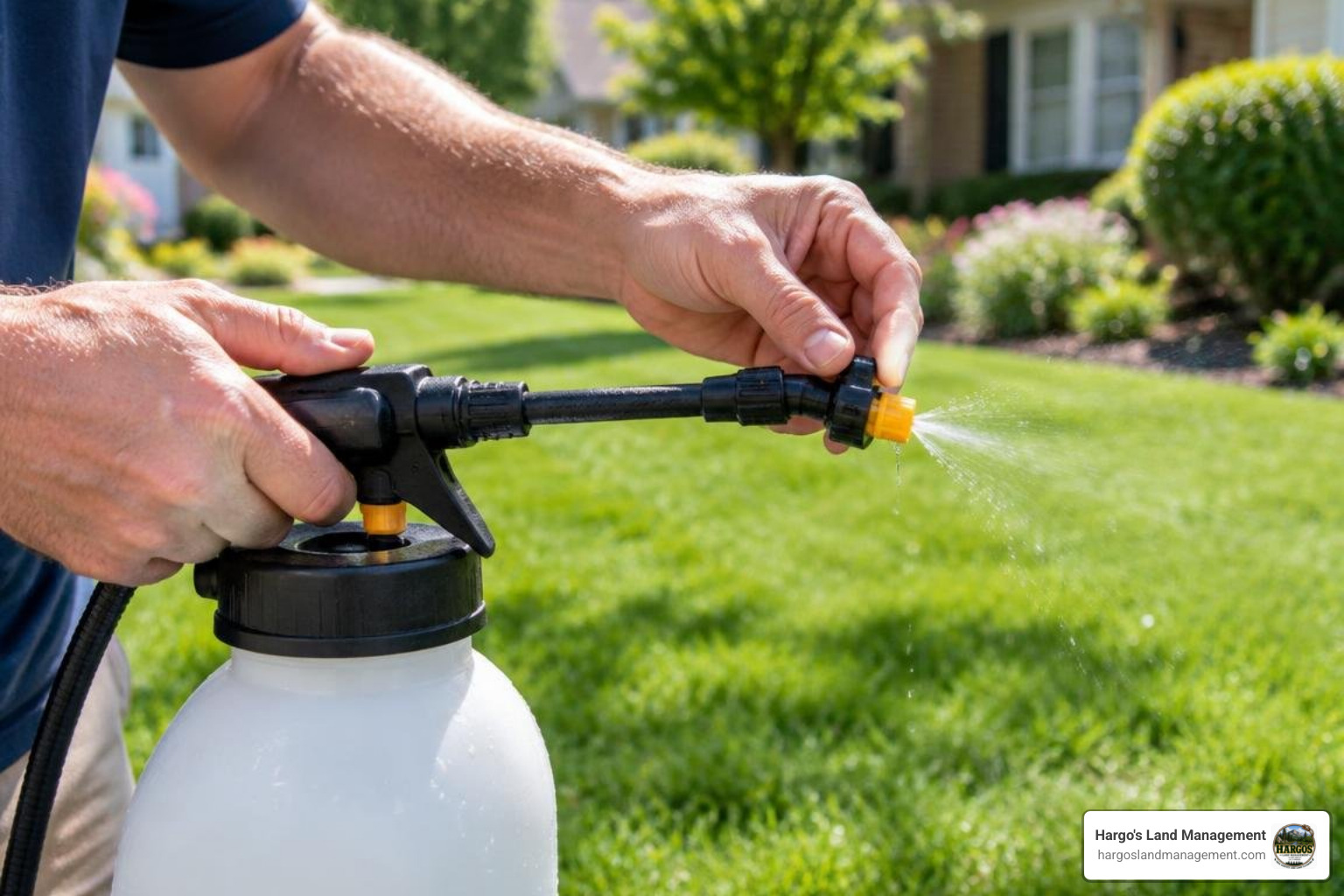
To ensure herbicide uptake:
- Add a Non-Ionic Surfactant: Mix a dedicated non-ionic surfactant into your spray tank to lower surface tension, allowing the solution to coat the leaves evenly. Never substitute household dish soap, as the degreasers in dish soap strip turfgrass cuticles and cause phytotoxic leaf burn.
- Use a Fan-Tip Nozzle: Equip your sprayer with a flat fan nozzle to produce even, medium-to-coarse droplets that maximize coverage while minimizing drift.
- Respect Rainfast Windows: Herbicides like Spurge Power require 4 to 6 hours of dry weather following application to absorb fully into the plant tissue.
For extensive properties or wildland-urban interface perimeters, integrating targeted spray applications into a broader vegetation management strategy keeps invasive weeds from migrating into turf areas.
Spot-Treatment Mixing Protocol and Equipment Setup
For spot-treating spotted and prostrate spurge in turf with a standard handheld or backpack sprayer:
- Water Volume: Fill the tank with 1 gallon of clean water.
- Herbicide Concentrate: Add 1.5 fluid ounces (approx. 3 tablespoons) of Spurge Power concentrate per gallon of water (treats approximately 1,000 sq ft of scattered weeds). For large commercial containers, a 2.5-gallon jug of Spurge Power retails for roughly $160 to $180 in 2026 and yields over 210 gallons of ready-to-use spray—costing about $0.08 per mixed gallon.
- Surfactant: Add 0.5 teaspoon of non-ionic surfactant per gallon of mixed solution.
- Indicator Dye: Add a few drops of blue spray tracking dye to avoid skipping patches or overlapping applications.
- Annual Limits: Do not exceed the maximum label limit of 1.47 fl oz of concentrate per 1,000 sq ft per year. Apply no more than 2 applications annually, spaced at least 21 days apart.
Temperature Thresholds, Rainfast Windows, and Mowing Schedules
- Temperature Window: Apply herbicides when air temperatures are between 65°F and 85°F. Spraying above 85°F increases the risk of turf burn and causes active ingredients like dicamba to volatilize and drift onto nearby landscape ornamentals.
- Irrigation Timing: If turf is drought-stressed, water the lawn thoroughly 24 hours before spraying. Stressed weeds close their stomata, reducing herbicide absorption. Avoid watering for 24 to 48 hours after application.
- Mowing Restrictions: Do not mow your lawn for 2 days before spraying (to ensure sufficient leaf surface area) and wait at least 48 hours after spraying before mowing again so the chemical translocates fully into the weed’s root system.
Integrated Turf Management and Non-Chemical Spurge Prevention
Herbicides are most effective when paired with cultural lawn care practices. Spurge thrives in thin, scalped, over-compacted turf. Maintaining a dense, tall grass canopy naturally deprives spurge seeds of the sunlight and warm soil temperatures they need to germinate.
Key cultural practices include:
- Raise Mowing Height: Maintain cool-season turf (Tall Fescue, Kentucky Bluegrass) at 3.0 to 4.0 inches throughout the summer months. Taller blades shade the soil surface, keeping it cooler than the 60°F–65°F germination threshold.
- Deep, Infrequent Watering: Water deeply (1 inch per week in a single or split session) rather than shallow daily watering. Spurge thrives on frequent, light surface moisture.
- Core Aeration & Overseeding: Aerate compacted soil in the fall and overseed bare patches to eliminate the thin spots where spurge establishes.
- Manual Extraction: For light infestations, hand-pull spurge when the soil is damp using a fishtail weeder to remove the complete central taproot. Always wear gloves to protect your skin from the milky latex sap, and bag pulled plants immediately rather than composting them.
- Organic Pre-Emergents: Applying corn gluten meal at 20 lbs per 1,000 sq ft in early spring acts as a natural root-inhibiting pre-emergent for chemical-free lawns. Additional chemical-free methods for beds, gravel, and borders can be found in How to Kill Spurge Without Chemicals 2026.
Frequently Asked Questions About Spurge Herbicide Control
How long does it take for spurge to die after herbicide application?
Visible signs of herbicide activity—such as leaf curling, twisting stems (epinasty), and yellowing—typically appear within 3 to 5 days after spraying. Complete systemic breakdown and root death take up to 14 days. If mature mats show partial green growth after 21 days, a second spot treatment may be applied according to label restrictions.
Can I use selective spurge killer without harming my lawn grass?
Yes. Selective broadleaf herbicides target dicot weeds (spurge, clover, dandelion) while leaving monocot grasses unharmed when mixed according to the label. Products containing 2,4-D, MCPP, and Triclopyr are safe on established cool-season grasses such as Kentucky bluegrass, tall fescue, and perennial ryegrass. For warm-season lawns like Bermuda and Zoysia, check label rates carefully and avoid spraying during high heat (above 85°F–90°F) to prevent temporary turf yellowing. Avoid using these products on sensitive species like St. Augustine, Centipede, or Dichondra unless explicitly permitted by the product label.
What safety precautions should I follow around children and pets?
Always wear long pants, chemical-resistant gloves, eye protection, and closed-toe shoes when mixing and applying weed killers. Keep children and pets off treated lawn areas until the spray has completely dried (typically 2 to 4 hours depending on humidity, temperature, and wind). Once dry, the active ingredients bind to the plant tissue and soil, significantly reducing exposure risks.
Conclusion
Controlling aggressive spurge infestations requires a coordinated approach: accurately identifying the weed, spot-treating actively growing patches with a selective broadleaf herbicide and surfactant, and applying pre-emergent barriers in early spring before soil temperatures hit 60°F.
For property owners throughout El Dorado County—including Placerville and South Lake Tahoe—maintaining weed-free turf and clear landscape perimeters is also essential for creating defensible space during fire season. At Hargo’s Land Management, our licensed, bonded, and insured team provides professional land clearing, brush mastication, hazard tree removal, and professional weed abatement tailored to foothill and mountain properties. Contact us today for a free on-site estimate to protect and safeguard your property.
CUSTOMER REVIEWS & TESTIMONIALS
We strive to exceed your expectations. See what our customers have to say.













CONTACT US TODAY
Serving El Dorado and Surrounding Counties
Locally owned and operated since 2013. Use our live chat support to get in touch about your land management needs today.
Request a free evaluation and estimate by completing our online form or book an on-site appointment.
El Dorado County: El Dorado Hills, Cameron Park, Shingle Springs, Coloma, Placerville, Camino, Pollock Pines, South Lake Tahoe and more...
Amador County: Jackson, Ione, and Surrounding Towns
Sacramento County: Sacramento and Surrounding Cities
Placer County: Roseville, Rocklin, Auburn, and Everything In Between
Nevada County: Penn Valley, Nevada City, Grass Valley