How a Certified Tree Risk Assessment Service Protects Your Property
How a Tree Risk Assessment Service Protects Your Property
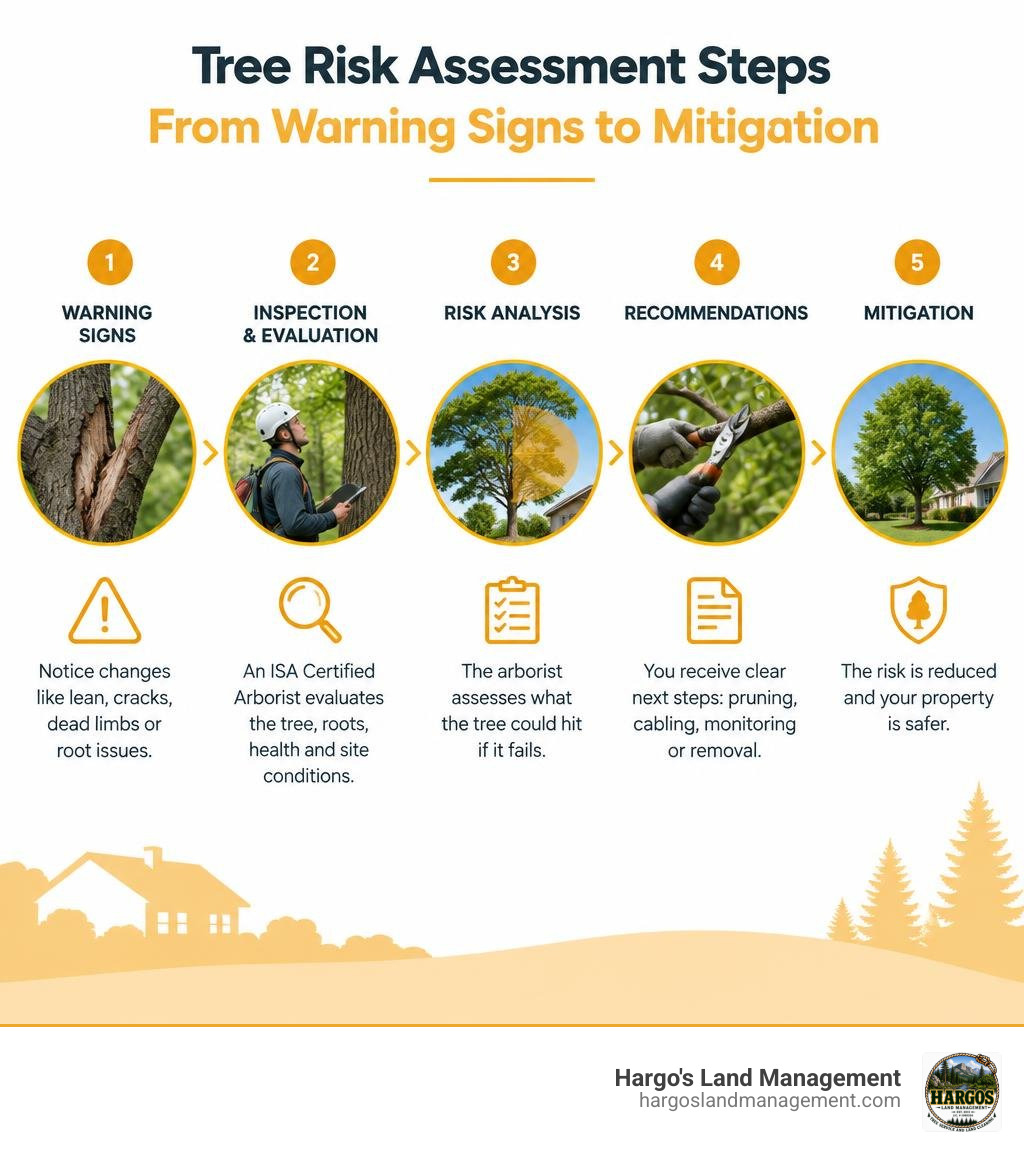
A professional tree risk assessment service helps you decide what to do before a tree or branch fails near your home, driveway, power line, or defensible space. If you notice a new lean, cracked limb, dead top, root heaving, cavity, or storm damage, keep people away from the area and schedule an assessment with an ISA Certified Arborist who holds the Tree Risk Assessment Qualification (TRAQ).
The arborist evaluates the tree’s structure, roots, defects, health, site conditions, and what the tree could hit if it fails. You then receive clear next steps, which may include pruning, cabling, monitoring, or removal when the risk cannot be reduced enough.
For El Dorado County property owners, this is also a practical wildfire-preparedness step. Deadwood, declining trees, and overcrowded vegetation can create hazards during high winds and fire season. A documented assessment helps you focus your budget on the trees that need attention first.
Relevant articles related to tree risk assessment service:
Understanding How a Tree Risk Assessment Service Evaluates Hazards
Every towering oak, cedar, and pine brings undeniable value to a landscape, but trees are biological structures subject to natural decay, mechanical load, and extreme weather. A proper risk assessment goes far beyond a casual glance at green leaves. It is a systematic, standardized process governed by ANSI A300 standards and the International Society of Arboriculture (ISA) Best Management Practices.
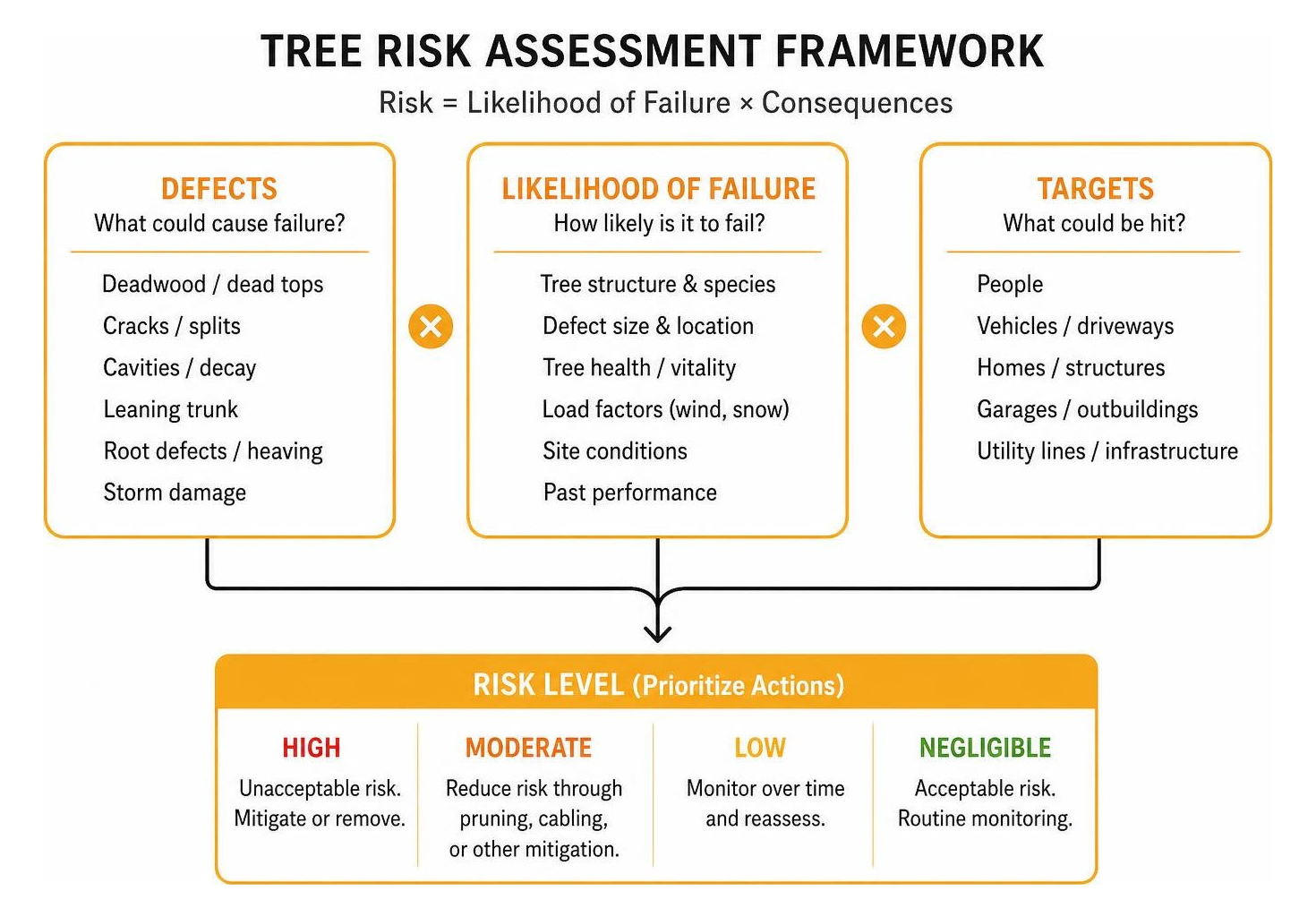
When our certified team conducts an evaluation, we balance tree biology with structural engineering concepts. We analyze whether the wood structure can withstand local wind loads, snow accumulation, and seismic movement while taking into account potential targets—people, vehicles, garages, and utility infrastructure.
By quantifying risk systematically rather than guessing, property owners gain actionable data. This process reduces liability, prevents catastrophic property damage, and ensures you do not cut down healthy, valuable trees out of unfounded fear.
Tree Health Inspection vs. Tree Risk Assessment Service
It is common for property owners to confuse a general tree health inspection with a comprehensive risk assessment, yet they serve very different goals:
- Tree Health Inspection: Focuses on biological vitality. An arborist looks at leaf color, annual shoot growth, foliar diseases, and pest infestations. A tree can have poor vitality (such as severe chlorosis or leaf aphid infestations) while remaining structurally sound and safe.
- Tree Risk Assessment: Focuses on structural stability, defect severity, and potential consequences of failure. Crucially, a tree can look vibrant and full of dense green foliage while concealing severe interior heartwood rot, a cracked trunk union, or severed anchor roots.
While vitality issues can eventually lead to structural decline, a risk assessment specifically examines what part of the tree could break, when it is likely to fail, and what it will crush if it falls. You can protect your home with a certified arborist tree risk assessment by ensuring that structural mechanics receive the same diagnostic attention as tree vitality.
The Three Levels of Professional Tree Risk Assessment
The ISA defines three distinct tiers of tree risk evaluation, matching the depth of inspection to the value of the surrounding property and the complexity of the tree:
- Level 1: Limited Visual Assessment (Walk-Through / Drive-By) A rapid visual screening designed to identify obvious, high-risk structural defects (such as severe leaning, large hanging branches, or uprooted plates) across a broad inventory of trees. Often utilized for large estates, commercial parks, or utility corridors.
- Level 2: Basic 360-Degree Ground Inspection The industry benchmark for residential and commercial evaluations. The arborist walks completely around the tree, evaluating the crown, trunk, root flare, and surrounding soil. It often includes ground-level tools like a nylon sounding mallet to detect internal decay, binoculars to inspect canopy crotches, and a soil probe to check the root zone.
- Level 3: Advanced Diagnostic Assessment Triggered when a Level 2 assessment reveals potential structural defects that cannot be fully diagnosed from the ground. Level 3 methods involve specialized equipment such as resistograph micro-drilling to measure remaining solid wood thickness, sonic tomography to map interior hollows, aerial canopy climbing inspections, or root collar excavation using pneumatic air spades.
| Assessment Level | Inspection Scope | Tools & Methods Used | Ideal Application |
|---|---|---|---|
| Level 1 | Broad visual scan from a single vantage point | Visual inspection, drive-by inventory | Large acreage, utility corridors, roadside screening |
| Level 2 | Complete $360^\circ$ ground inspection of crown, trunk, root flare | Mallet sounding, binoculars, measuring tape, soil probe | Residential trees near houses, permit applications |
| Level 3 | Advanced, invasive or diagnostic testing | Resistograph, sonic tomography, aerial climbing, air spade | Historic or high-value trees with suspected internal decay |
Key Factors and Diagnostic Standards Evaluated by TRAQ Arborists

ISA TRAQ (Tree Risk Assessment Qualification) is the global gold standard for evaluating tree hazards. Arborists renew this credential every five years through rigorous field and written examinations. When applying TRAQ protocols, our arborists do not make arbitrary guesses; we use a standardized risk matrix that correlates the Likelihood of Failure, the Likelihood of Impacting a Target, and the Consequences of Failure.
Structural Defects, Decay Detection, and Root Stability
A tree’s structural integrity depends on its wood density, attachment geometry, and root architecture. During an evaluation, we carefully analyze:
- Co-Dominant Stems and Included Bark: Stems that grow together in a tight “V-shape” rather than a strong “U-shape” often pinch bark inside the union. Over time, expanding growth exerts outward leverage, making these unions prime candidates for splitting in high winds.
- Fungal Conks and Trunk Cavities: Fruiting bodies (mushrooms and conks) growing on the trunk or buttress roots often signal advanced internal wood decay. By using specialized sounding techniques, we can map out hollows.
- Root Collar Defects & Soil Girdling: Buried root flares can suffocate roots or cause girdling roots that choke water transport and compromise tree anchoring. Detailed structural diagnostics and below-ground health analysis ensure root stability is never ignored.
Site Load Factors, Target Proximity, and Failure Probability
A tree standing in an open meadow far from people carries almost zero risk, regardless of defects, because it lacks a target. A target is defined as people, structures, vehicles, or infrastructure that could be damaged or injured should a failure occur.
We evaluate:
- Wind and Snow Exposure: Trees left standing after nearby lot clearing experience sudden new wind loads (“windthrow” exposure).
- Target Occupancy Rates: A tree towering over a child’s bedroom or a main road carries higher consequence potential than one over an unused back corner of a garden.
- Canopy Weight Distribution: Asymmetrical lean or heavy, over-extended lateral limbs create immense torque during storms.
When defects and high-value targets align to create unacceptable hazards, we deploy safe high-risk tree removal solutions for hazardous trees near you to eliminate the danger.
Identifying When Property Owners Need Hazardous Tree Evaluations

Many property owners wait until severe weather hits before looking closely at their trees. However, proactive inspections reveal subtle structural warning signs months or years before a catastrophic break.
Critical Warning Signs and When to Book a Tree Risk Assessment Service
You should schedule a professional assessment if you spot any of the following red flags:
- Soil Heaving or Cracking at the Base: Freshly mounded soil or exposed root tips on the side opposite a tree’s lean mean the root plate is failing.
- Sudden Lean: A tree that has grown at an angle for decades has adapted with reaction wood, but a tree that shifts angle after rain or wind is in active failure.
- Large Deadwood (Widowmakers): Dead branches larger than 2 inches in diameter will eventually drop as wood-decay fungi weaken their attachments.
- Cavity Expansion or Oozing Seams: Cracks running down the trunk, weeping bark, or hollow openings that house pests or collect moisture indicate interior weakness.
- Post-Storm Stress: Heavy snow loads, torn branch collars, or lightning strikes weaken structural integrity.
Regular maintenance and timely inspections allow property owners to maintain healthy trees across Placerville, Auburn, and Lake Tahoe through all four seasons.
Permitting, Real Estate, and Wildfire Defensible Space Compliance
Tree risk assessments play an essential role in legal compliance, home transactions, and regional safety:
- Municipal Tree Removal Permits: Many local councils protect native oaks, pines, and historic trees. When a protected tree becomes hazardous, a formal TRAQ report is often the required document that justifies emergency removal permits.
- Insurance Underwriting & Real Estate Deals: Insurers increasingly inspect properties for hazardous limbs overhanging roofs. A signed arborist assessment can satisfy underwriters or help buyers negotiate repairs before closing.
- Wildfire Defensible Space Requirements: In fire-prone regions like El Dorado County, dead or structurally unsound trees create hazardous ladder fuels and high-risk crown fire pathways. Combining a structural evaluation with defensible space clearing allows you to address fire hazards efficiently. Reviewing understanding defensible space zones and tree spacing rules will help you reduce wildfire dangers and protect your perimeter.
Mitigation Solutions, Cost Factors, and Formal TRAQ Reports
Receiving a tree risk assessment does not mean your tree will automatically be slated for removal. In fact, certified arborists prioritize tree preservation whenever structural stability can be restored through science-based mitigation.
Non-Invasive Mitigation and Structural Preservation Options
Depending on the specific defect diagnosed, arborists have several proven mitigation strategies:
- Crown Reduction and End-Weight Relief: Trimming excessive foliage from long, heavy lateral limbs reduces wind resistance and mechanical leverage. Research shows proper structural pruning significantly reduces failure rates during high-wind events.
- Supplemental Support (Cabling and Bracing): Installing flexible dynamic cables or high-strength steel hardware high in the canopy redistributes loads between co-dominant stems, preventing splits during heavy snow or storms.
- Root Zone Management and Mulching: Alleviating soil compaction, correcting drainage, and applying organic mulch can stimulate healthy anchor root development.
- Target Moving: Sometimes the simplest solution is moving the target—relocating a picnic table, parking spot, or shed out of the tree’s fall zone.
When pruning is warranted, avoid damaging practices like topping; always use safe structural pruning alternatives to tree topping and partner with a licensed, experienced tree service.
TRAQ Report Components, Documentation Value, and Pricing Factors
When you request a formal assessment, you receive a comprehensive written document that serves as a legal and technical record. A complete TRAQ report contains:
- Tree Identification & Site Map: Species, diameter at breast height (DBH), height, and exact GPS or plotted location.
- Defect Inventory & Crown Condition: Quantitative details of cracks, hollows, decay conks, lean angles, and deadwood volume.
- Target & Exposure Assessment: Description of all high-value targets within the potential strike zone.
- Standardized Risk Matrix Score: Documented likelihood of failure (improbable, possible, probable, imminent) matched against consequence severity (negligible, minor, significant, severe), resulting in an overall risk rating (Low, Moderate, High, or Extreme).
- Mitigation Action Plan: Clear timelines and recommendations for pruning, cabling, reinspection frequency, or removal.
- Photographic Evidence: High-resolution annotated photos documenting diagnosed defects for insurers, HOAs, or permit officers.
For additional perspectives on hazard evaluation standards and professional credentials, consult the International Society of Arboriculture.
Frequently Asked Questions About Tree Safety Assessments
How much does a professional tree risk assessment cost?
Assessment pricing depends on the level of inspection, number of trees, equipment requirements, and whether a formal written report is needed for municipal permits or court documentation:
- Standard Level 2 Visual Assessment (Single Tree): Typically ranges from $150 to $350 for a single tree inspection and basic written assessment.
- Comprehensive TRAQ Report (Permit/Legal Submission): Detailed reports featuring high-resolution photo documentation, risk matrices, and mitigation plans usually cost $450 to $1,200, depending on tree size and site complexity.
- Level 3 Advanced Diagnostics: Evaluations requiring sonic tomography, resistograph micro-drilling, or canopy climbing generally range between $750 and $2,500+.
- Multi-Tree / Commercial Site Surveys: Parcel surveys and HOA canopy audits are typically quoted per tree or billed at daily consulting rates ($1,000 to $5,000+).
How do I find a qualified ISA TRAQ-certified arborist?
Not all tree workers possess certified diagnostic training. To verify qualifications:
- Search the ISA Directory: Use the “Find an Arborist” verification tool on TreesAreGood.org.
- Verify TRAQ Credentials: Confirm the arborist holds active Tree Risk Assessment Qualification credentials alongside their baseline ISA certification.
- Check Licensing and Insurance: Ensure the company carries comprehensive general liability and worker’s compensation insurance to protect your property during evaluations. Working with an ISA certified arborist guarantees industry-standard diagnostics.
Can a tree risk assessment save my tree from removal?
Yes! A professional risk assessment frequently saves trees that property owners feared were doomed. Unqualified tree cutters often recommend complete removal because they lack the diagnostic tools to measure internal strength or install supplemental support systems. An ISA arborist can often prescribe targeted crown thinning, weight reduction, or dynamic cabling to reduce risk to acceptable levels, preserving the shade, beauty, and value of your mature trees.
Conclusion
Trees provide immense ecological value, beauty, and shade to our properties, but large or aging trees can turn into severe liabilities if structural defects go undetected. Relying on guess-work or waiting for a winter storm to reveal structural flaws puts your home, family, and finances at unnecessary risk.
By booking a certified tree risk assessment service, you receive clear, science-backed guidance to protect your landscape. Whether the solution involves structural pruning, dynamic cabling, routine monitoring, or full removal, having a TRAQ-qualified professional evaluate your canopy gives you complete peace of mind.
At Hargo’s Land Management, we are proud to serve residential and commercial property owners across El Dorado County, including Placerville, Auburn, and South Lake Tahoe. As a locally owned, fully licensed, bonded, and insured team, we provide rapid, high-quality assessments, defensible space clearing, and hazardous tree removal services with free on-site estimates.
Protect your home, reduce your liability, and prepare your property for any season. Contact our expert team today to schedule your comprehensive tree risk evaluation.
CUSTOMER REVIEWS & TESTIMONIALS
We strive to exceed your expectations. See what our customers have to say.













CONTACT US TODAY
Serving El Dorado and Surrounding Counties
Locally owned and operated since 2013. Use our live chat support to get in touch about your land management needs today.
Request a free evaluation and estimate by completing our online form or book an on-site appointment.
El Dorado County: El Dorado Hills, Cameron Park, Shingle Springs, Coloma, Placerville, Camino, Pollock Pines, South Lake Tahoe and more...
Amador County: Jackson, Ione, and Surrounding Towns
Sacramento County: Sacramento and Surrounding Cities
Placer County: Roseville, Rocklin, Auburn, and Everything In Between
Nevada County: Penn Valley, Nevada City, Grass Valley